
Have you ever heard of BIM (Building Information Modeling)?
This methodology is revolutionizing the way architecture and engineering projects are designed and built.
Year after year, more companies adopt BIM in their projects. In Brazil, for example, the percentage of construction companies using BIM jumped from 9.2% in 2018 to 20.6% in 2024.
But BIM is not just about creating a beautiful 3D model on a computer screen.
In fact, there are several BIM dimensions that expand the possibilities of the digital model, adding information such as time, cost, sustainability, and much more.
If you’ve ever heard terms like 4D, 5D, or 6D and wondered what they mean, stick with us!
In this article, we’ll explain what BIM dimensions are, what they’re used for, which are the 10 most important types, and when it makes sense to use them.
So, let’s dive in! Enjoy the read!
What is a BIM dimension?
A BIM dimension is, essentially, an extra layer of information added to the project’s digital model.
In other words, BIM goes far beyond traditional three-dimensional modeling. It incorporates other “dimensions” of data, such as time, cost, sustainability, safety, and operations, into the virtual model.
This means that every phase of the construction lifecycle,from initial design and construction to post-occupancy maintenance,can be managed in an integrated way within the BIM environment.
In a complete BIM model, you can plan the project schedule, estimate budgets, evaluate energy performance, and even schedule future maintenance using the same 3D model.
Each BIM dimension represents a layer of information tied to the project’s geometry.
It’s important to note that there is no strict global standard for BIM dimensions. In other words, some sources may list different terms or numbers.
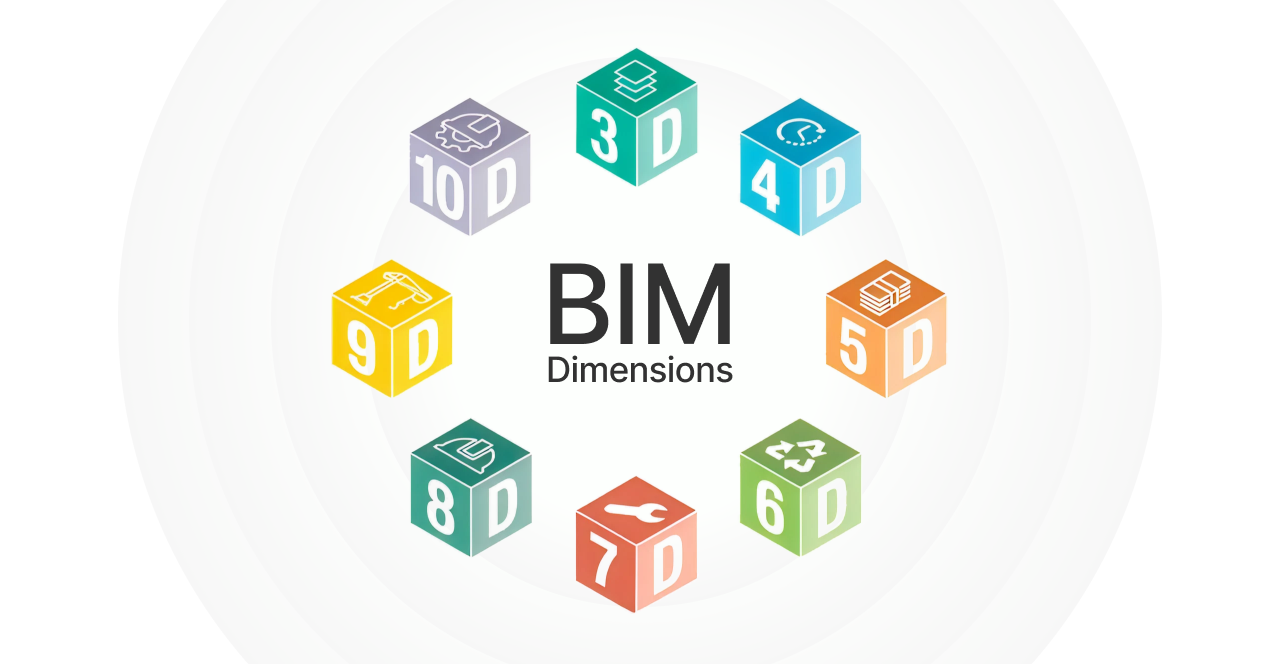
Still, the industry generally recognizes up to 10 main BIM dimensions (3D, 4D, 5D, 6D, 7D, and beyond).

Stephannie Serafini
Architect and Marketing Analyst | Blocks®
“BIM dimensions are essential to a project because they turn a 3D model into a comprehensive management tool. For example, with 4D we can connect each element to the schedule, avoiding clashes before construction even starts. At 6D, we can simulate energy performance and cut consumption right at the design stage. Meanwhile, 7D consolidates maintenance data, ensuring more cost-effective operations over the building’s lifecycle. This way, our team gains predictability, savings, and quality in a consistent, transparent manner.”
What are BIM dimensions used for?
BIM dimensions exist to make the design and construction process more efficient, accurate, and collaborative.
By embedding information on planning, cost, sustainability, and more into the model, professionals can digitally simulate different aspects of a project and anticipate issues before they occur in the real world.
This translates into fewer mistakes, less rework, smarter use of resources, and better-planned projects.
In other words, integrating BIM dimensions helps minimize design–construction conflicts, which in turn reduces costs and material waste.
According to studies, using 4D and 5D BIM processes can cut project planning time by up to 20%, reduce material costs by around 15%, and lower the risk of construction delays by as much as 30%.
Overall, BIM dimensions enhance decision-making at every stage, from visualizing the design in 3D to managing long-term building maintenance.
What are the types of BIM dimensions?
Now that you know what BIM dimensions are used for, it’s time to explore their different types.
Today, the main BIM dimensions are generally identified by numbers, with each one adding a new layer of information to the model.
Let ‘s take a look?
Three-dimensional modeling (3D)
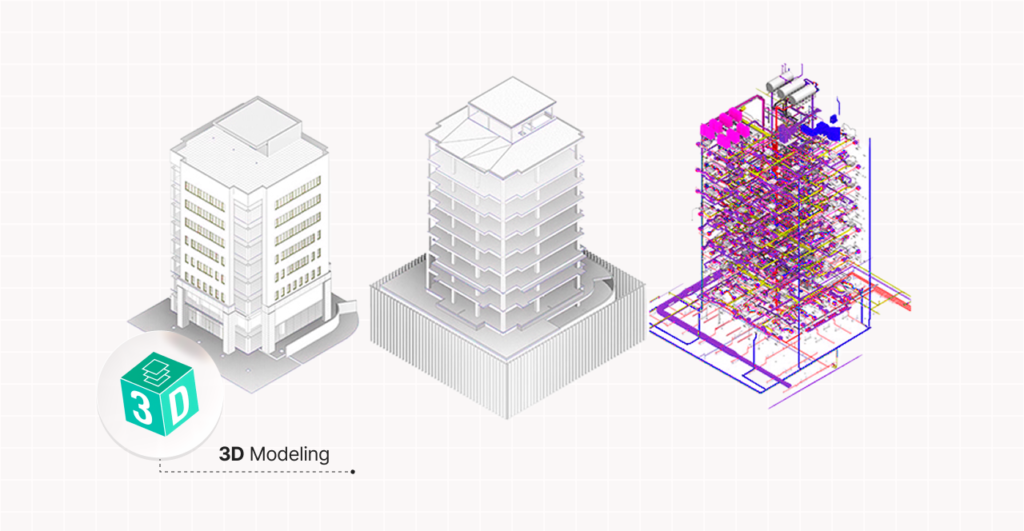
The 3D dimension is the foundation of the entire BIM methodology, representing a project in three spatial dimensions: width, height, and depth.
In other words, 3D BIM is essentially the project’s digital model, containing all of its building elements.
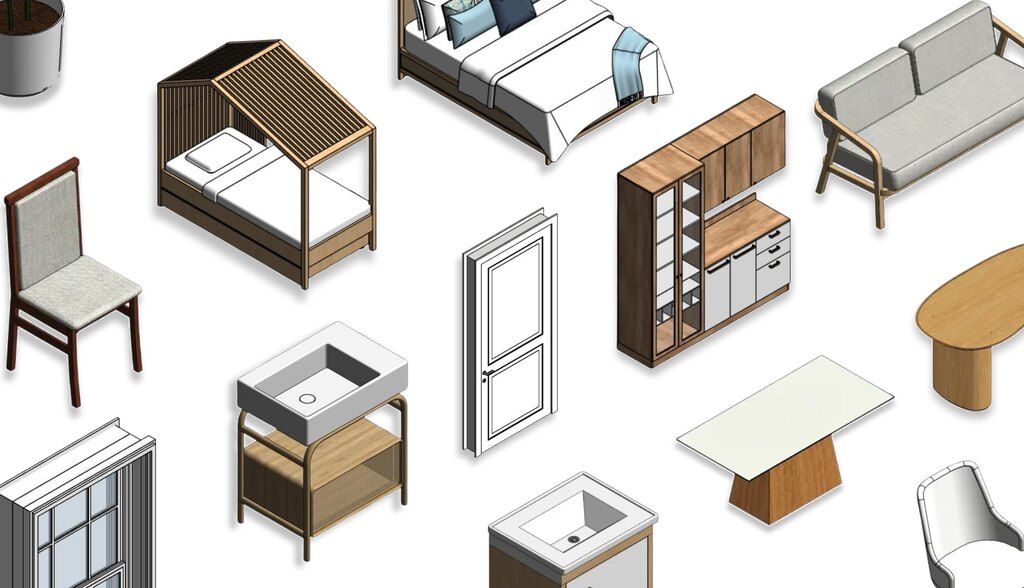
Walls, floors, columns, doors, and furniture are examples of components represented digitally in 3D.
In short, the 3D dimension of BIM delivers a complete digital model of the building, serving as the basis for all other dimensions.
It provides clearer visualization, improves communication among stakeholders, and helps reduce design errors by allowing the project to be reviewed in detail within a virtual environment.
Planning (4D)
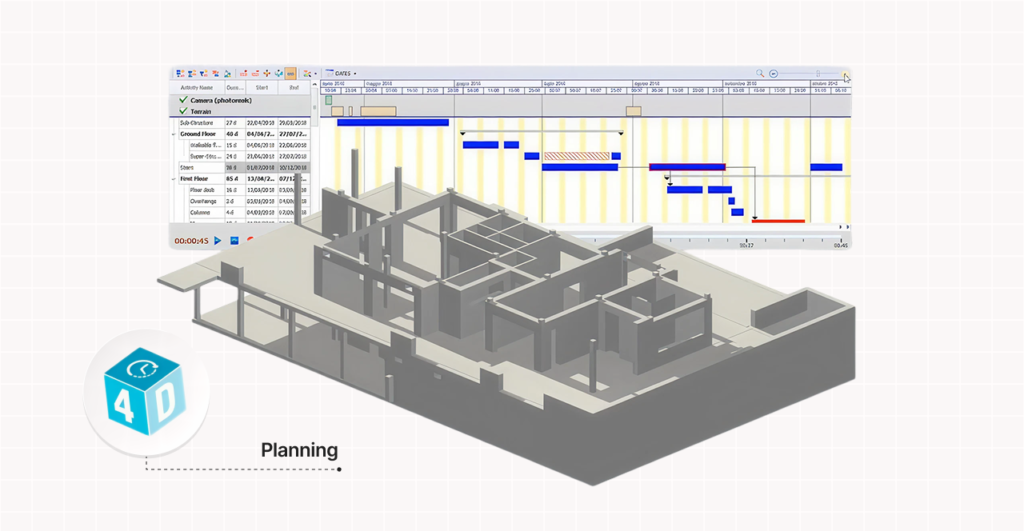
Often referred to as 4D BIM or 4D simulation, this dimension links the 3D model to scheduling data and construction phases.
In other words, 4D = 3D + time.
This integration makes it possible to visualize and manage the project timeline alongside the digital model, simulating how construction will unfold step by step.
In practice, 4D BIM lets us create a kind of virtual video of the project being built, with each model element tied to specific tasks and dates.
In complex projects, 4D BIM proves highly valuable for project management, offering a clear time-based view of the build and making coordination meetings more effective.
With construction deadlines becoming tighter and tighter, the 4D dimension is gaining traction as a way to ensure on-time delivery with fewer surprises.
It’s no coincidence that public agencies and large-scale projects increasingly require 4D simulations in their workflows.
Cost Estimating (5D)
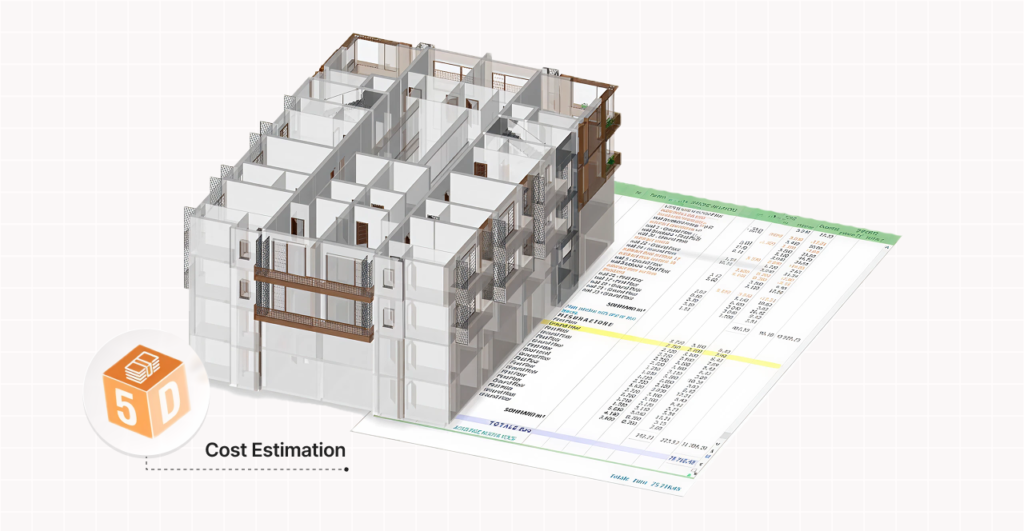
The 5D dimension adds the cost factor to the BIM model. In other words, 5D BIM = 3D + 4D + budget data.
Here, each component of the 3D model is linked to financial information, such as material prices, labor, equipment, and more.
In a 5D workflow, as the project evolves or changes, cost data updates automatically in real time.
“So, what are the advantages?” First, estimating becomes far more accurate and efficient.
BIM software can extract quantities directly from the model and multiply them by unit costs, producing instant cost estimates.
That means if an architect changes a finish or enlarges a room, the impact on the budget shows up immediately.
Another key benefit of 5D BIM is the ability to spot potential cost overruns.
By linking the schedule (4D) with costs (5D), teams can track cash flow across the project timeline and identify spending peaks in advance.
Sustainability (6D)
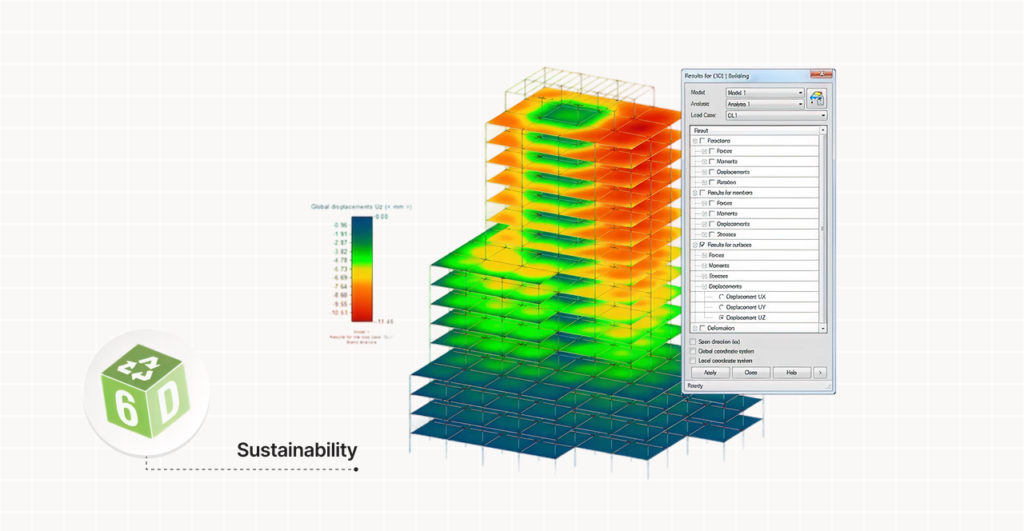
The 6D dimension of BIM focuses on sustainability and a building’s environmental performance.
Here, the BIM model incorporates data and analyses on energy efficiency, resource consumption, and environmental impact across the entire lifecycle.
In other words, 6D BIM makes it possible to simulate and optimize sustainable performance before a is even built.
With 6D, teams can run environmental analyses directly in the model, including:
- calculating a building’s energy use;
- simulating thermal behavior (insulation, shading, and daylighting analysis);
- estimating water consumption, carbon footprint, and other sustainability metrics.
For instance, designers can test different façade materials in the model to see how each option affects thermal comfort and energy demand for air conditioning.
In addition, 6D BIM supports green building certification strategies, such as those required for LEED, AQUA, and similar standards.
In short, the 6D dimension brings the environmental factor into BIM, enabling architects and engineers to make choices that are both sustainable and cost-effective.
Asset management (7D)
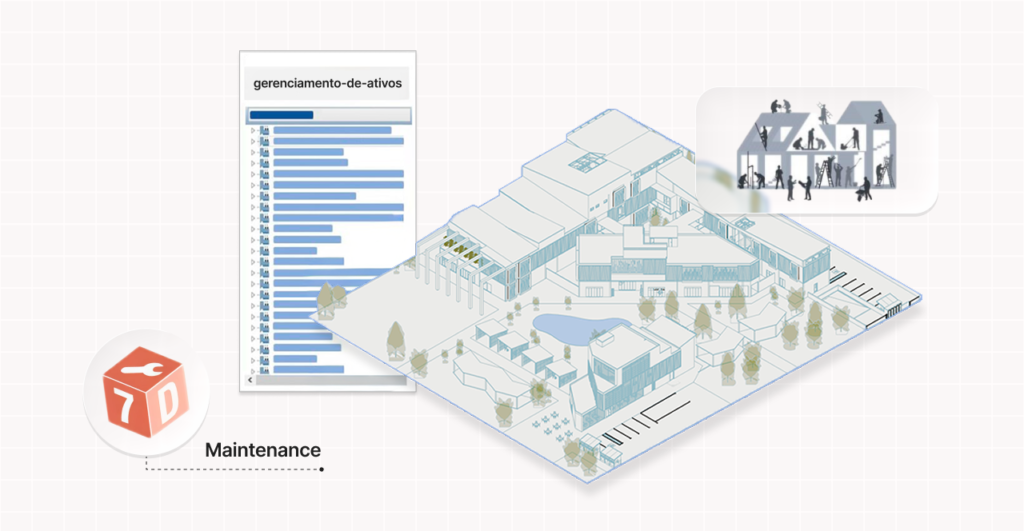
The 7D dimension extends BIM into the operations and maintenance phase, after construction is completed.
Often referred to as BIM for FM (Facilities Management), this dimension adds information needed to managing the built asset throughout its entire lifecycle.
A 7D BIM model serves as a centralized digital platform that stores all data on the building’s systems and components.
With this integration, owners or facility managers can plan preventive and corrective maintenance with greater accuracy, using historical data and sensors to schedule services before unexpected failures happen.
As a result, 7D BIM supports predictive maintenance, identifying potential issues and boosting operational efficiency, which prevents both unexpected costly downtime and unnecessary interventions.
Are there other BIM dimensions?
In addition to the established dimensions up to 7D, some professionals and publications refer to new additional BIM dimensions. There is no universal agreement, but the most common are:
- Safety (8D): focuses on health and safety on construction sites. It brings into the model data on safety planning, risk identification, and accident prevention measures. With 8D, teams can simulate construction phases with worker safety in mind, anticipate hazardous conflicts, and ensure compliance with safety standards right from the design stage.
- Lean Construction (9D): aims to cut waste and boost efficiency in construction processes by integrating lean methods into the digital model. This dimension allows for workflow analysis, value stream mapping, and the identification of non-value-adding activities, all within the BIM environment.
- Industrialized Construction (10D): applies BIM to industrialization and prefabrication. It emphasizes designing with modular components and off-site construction methods. Typically, it’s used to plan the automated production of parts, full 3D modules, precast panels, and other elements that are later assembled on-site.
Beyond these, some sources even mention “11D,” “12D,” and beyond, incorporating aspects such as life-cycle assessment (LCA) or urban asset management.
The important thing to understand is that BIM is constantly evolving, and new dimensions will continue to emerge as technology and industry needs progress.
Still, BIM’s success isn’t about stacking as many dimensions as possible, it’s about integrating the right data effectively and fostering real collaboration across teams.
In other words, having “10D” won’t help much if the team isn’t prepared to use the information wisely.
When should you use BIM dimensions?

With so many options, it’s natural to ask: when should each BIM dimension be applied to a project?
The answer depends on the project’s scale, the client’s goals, and the team’s BIM maturity.
Not every project needs every dimension and that’s perfectly fine. What matters is using the ones that deliver real value for the situation.
For smaller or less complex projects, 3D modeling (BIM 3D) alone is often enough to improve coordination and visualization.
As projects grow in size and complexity, the need for detailed planning increases.
That’s when 4D becomes especially useful for sequencing tasks and preventing schedule clashes.
If cost control is critical (and it almost always is), integrating 5D can be a game-changer.
Projects with sustainability targets, such as green buildings or those seeking environmental certifications, benefit greatly from 6D, which helps optimize energy and environmental performance early in design.
For owners who will operate a facility long-term, like hospitals, factories, retail chains, or public buildings, it is highly recommended to invest in 7D (maintenance).
So always ask: who will use the model, and for what purpose? If planning, cost, sustainability, or maintenance gains are clear, these BIM dimensions should be included in the scope.
It’s also important to consider the readiness of your team and your client.
Implementing advanced dimensions requires the right software (such as Revit), skilled professionals, and well-structured workflows.
Forcing every dimension doesn’t work if stakeholders aren’t prepared or if the project doesn’t demand it.
In short, use BIM dimensions only when they provide measurable value to your project.
Want to make BIM design easier? Try the Blocks Plugin
Working efficiently in BIM takes more than knowledge, it also requires the right tools…
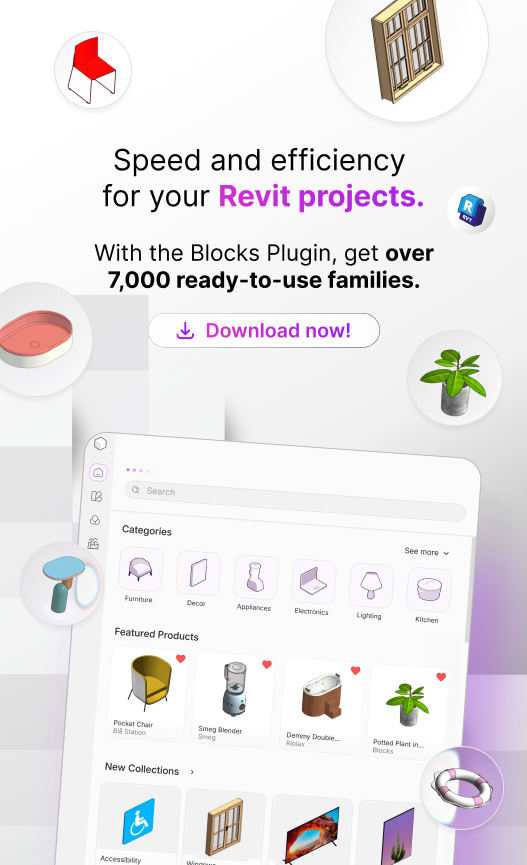
Imagine speeding up your 3D modeling with instant access to a vast library of parametric BIM families, ready to drop into your project.
With the Blocks Plugin for Revit, that’s exactly what you get.
Our plugin gives you access to a complete library of more than 7,000 high-quality BIM families, ready to insert into your models in just a few clicks.
We’ve got families for architecture, interior design, furniture, equipment, materials, textures, and much more. And the best part? It is all free!
Still not convinced? Download the plugin today and see for yourself!
Conclusion
Did you enjoy learning about BIM dimensions? They show just how broad and powerful the BIM methodology really is.
Understanding and applying these dimensions is without a doubt a competitive edge for AEC students and professionals who want to stand out.
More than just acronyms, BIM dimensions represent a true mindset shift: approaching projects in an integrated, collaborative, and data-driven way.
Bringing them to your workflow is like giving your project a boost of productivity, cost savings, and higher-quality results.
We hope this article has helped clarify each BIM dimension and inspired you to keep expanding your knowledge in the field.
And remember: BIM technology and practices are constantly evolving. Keep learning and staying on top of the latest trends to remain ahead of the curve! 😉
To do that, be sure to follow the Blocks blog and connect with us on TikTok, YouTube, Instagram, and LinkedIn.