

If you work in architecture, interior design, or construction, you’ve probably heard of the BIM (Building Information Modeling) methodology.
But have you heard of BIM digitization? This is an area of BIM in which investment from manufacturers is becoming increasingly important.
BIM digitization has strong upside for manufacturers looking to get their products specified more often by plugging them directly into Architecture, Engineering, and Construction (AEC) projects.
A BIM library can drive a powerful organic marketing demand: specifiers and clients can access your products digitally and drop them straight into their models.
As a result, your brand and products gain outsized visibility with AEC professionals, nudging specs and purchase decisions in your favor.
Curious how BIM digitization can help your company? This guide from Blocks walks you through the essentials.
What Is BIM digitization?
BIM digitization, also known as BIM for manufacturers, is the process of building a virtual version of a physical product (a BIM object) enriched with detailed product data.
This digitization is done in BIM software, such as Revit, where a parameter-driven virtual model of the real-world product is created, complete with all key specifications: geometry, functionality, materials, and performance data for each component.
Parametrization lets designers work with real-world data from the start, avoiding the need to manually calculate dimensions.
When a designer changes the project, a parameterized object updates automatically to fit the new design, something traditional CAD tools can’t do.
How does BIM digitization process work?

Each company specializing in BIM digitization has its own workflow. However, the core stages usually include 3D modeling, data, analysis, and ongoing maintenance.
At Blocks®, a BIM digitization specialist, our process follows four clear steps::
- Planning: We start by analyzing the company’s portfolio, market, and goals to define the most effective BIM strategy for each product.
- Specification: Next, we map out the product’s intended uses, determine the required level of detail, and ensure compliance with all relevant industry standards.
- Development: We then create the BIM objects in specialized software, organizing geometry and data in a smart, efficient structure. Our optimized workflow enables seamless integration and even delivery in augmented reality when needed.
- Validation: Finally,we conduct rigorous testing and quality checks, in partnership with the client, before delivering the finished BIM library, guaranteeing precision and reliability.
In general, these are the steps we follow to build BIM libraries for our clients.
With this proven process, we’ve earned the trust of over 160 manufacturers worldwide.
One standout example is our collaboration with Portobello. Read more in our case study: “Successful BIM Digitization: The Collaboration Between Portobello and Blocks.”
The key advantages of BIM digitization
By simply adopting the BIM methodology in AEC projects, architecture, interior design, or engineering firms can already enjoy countless benefits.
According to the study “How to Measure the Benefits of BIM—A Case Study Based Approach“ by Kristen Barlish and Kenneth Sullivan, implementing this methodology can reduce costs by 6.9% to 20%, depending on the company’s size.
However, when it comes to product BIM digitization, the benefits are even more specific. Here are some key advantages:
1. Increased market visibility

Without a doubt, one of the main benefits of BIM digitization is increased market visibility.
By creating a BIM library of your products and making them available on your website, or even on BIM platforms, like Blocks, you ensure that architects and engineers can easily access and use your products.
Applying them in projects is simple: professionals just download the object and insert it directly.
A G4BIM study on “Benefits of BIM for Manufacturers” indicates that BIM digitization makes it easier for professionals and clients to access product details, pricing, and purchase links, boosting the likelihood of purchase.
2. Product parametrization

Parametrization is another major advantage of BIM objects.
BIM objects have parametric information, such as editable dimensions, materials, and attachment points, in addition to metadata, which clarify technical aspects and eliminate uncertainties during the project.
Having this data in real time prevents future rework and facilitates adjustments when changes occur.
Research by Chathuri Widanage on “Integration of Design for Manufacture and Assembly (DfMA) with BIM in Infrastructure” shows that 30% of on-site rework is avoided when designers use detailed BIM objects, as conflicts and errors are identified before construction.
3. Cost reduction

Cost reduction is another key benefit.
Some cost-benefit analyses show a 6.9% to 20% reduction in total project costs when manufacturer BIM objects are used during the detailing phase.
For instance, in a commercial building project in Hong Kong, the use of parameterized manufacturer objects resulted in a 6.92% overall cost saving.
With digitized products, clients and professionals can accurately verify whether a specific item matches the construction requirements.
4. Marketing

When we talk about BIM digitization, we are referring directly to product marketing.
One of the biggest challenges for manufacturers is generating leads on their products, especially in a competitive AEC market.
Marketing in BIM digitization is almost instantaneous, since the professional chooses an object in the BIM library, adds it to the project, gets approval from the client, and, if approved, the product can be purchased.
Integrating into the BIM software libraries is a great differentiator for any company. This ensures direct contact with the client’s project, increasing brand visibility and, consequently, the chances of selling the product.
A survey by Polyroof/NBS Whitepaper showed that companies that digitized their products and made them available directly in the software saw an 80% increase in inquiries and were specified 50% more often in projects.
Collecting data on the use of your products in BIM libraries allows for more targeted marketing campaigns. This happens because you will have visibility into which products are most specified in projects.
5. Sustainability and operational efficiency

The BIM methodology is based on sustainability, as the technology helps minimize material waste and reduce the need for on-site rework.
By predicting exact material quantities and simulating the project virtually before construction, errors and conflicts can be identified and resolved early, further reducing costs and waste.
In short, BIM digitization supports sustainable practices while making construction more efficient and cost-effective.
Why should manufacturers develop BIM content?
For those who develop AEC products, offering only physical catalogs or static PDFs is no longer enough.
The creation of a BIM library reduces project errors by up to 30%, reduces rework costs in the field by around 20%, and saves time on budgeting and planning.
In addition to simplifying the routine of architects and engineers, this direct integration increases the visibility of the manufacturer’s product in searches within platforms, such as Revit.
The standardization of BIM objects also provides manufacturers with technical credibility.
Following international standards such as ISO 19650 and adopting interoperable formats such as IFC demonstrates a commitment to quality and opens doors to projects that require high reliability.
It is not uncommon to find situations in which, even competing on equal terms, the manufacturer who has BIM content has up to 25% a greater chance of being quoted in a project.
Finally, when we look at the return on investment metric, the numbers speak for themselves: manufacturers who digitize their entire product line in BIM usually achieve an average ROI above 300% in just two years.
In essence, we are not just talking about a technological luxury, but about a strategic decision that directly impacts a manufacturer’s revenue, operational efficiency, and reputation in the AEC market.

Bárbara Pavanello
CEO | Blocks®
“The digitization of products in BIM provides a complete experience for the designer. Instead of a catalog or PDF, they have access to an intelligent object with information about fitting, behavior, and contribution to the project’s sustainability. Specification becomes clearer, technical visits and delays are avoided, and confidence increases. The professional can visualize the product working in a virtual environment before the purchase, which ensures there will be no unforeseen events on the construction site. BIM digitization is more than 3D modeling; it’s about peace of mind and credibility, elements that make all the difference for those who design.”
Want to start gigitizing your products? Count on Blocks!
Have you realized the importance of starting to digitize your products? Then, take the first step into BIM digitization and partner with a specialist like Blocks.
At Blocks, you have access to a team specialized in BIM development that will create a library with all the necessary specifications for your clients.
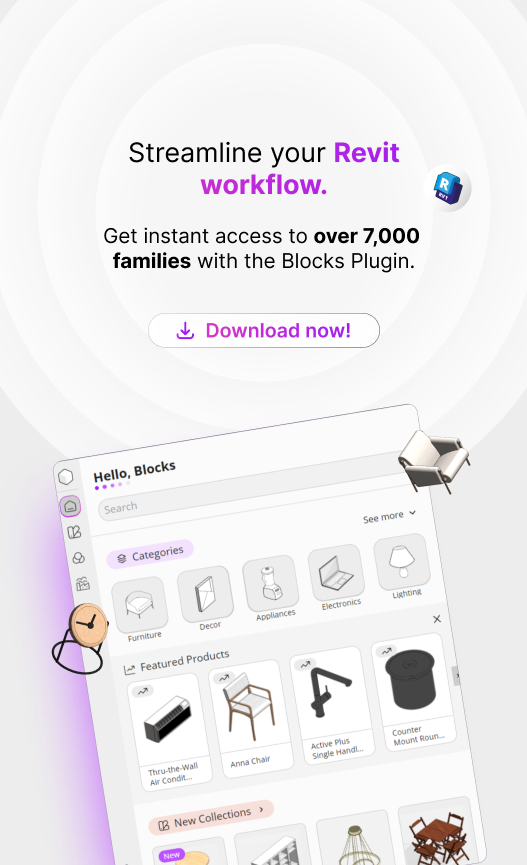
Your company will not only have its own BIM library, but we will also make it available in our Revit plugin, allowing professionals to access your products directly.
We are excited that you have decided to take the first step towards BIM digitization! Talk to one of our consultants for more information.
Conclusion
BIM digitization is more than just an investment in virtual modeling; it’s a way to invest in the future of your business. BIM is the future of civil construction and is already being made mandatory in several countries, including Brazil.
Creating BIM content for your products is a way to stand out among the many competitors in the AEC industry.
So, don’t miss out on the opportunity to digitize, and count on Blocks! Contact one of our consultants right now.
Did you like this content? For more like it, access the Blocks blog.