

If you are an architect, engineer, or interior designer who works with BIM, you may have wondered what it takes to become a BIM Manager.
A BIM Manager is the professional responsible for leading BIM implementation within a company and defining the standards, processes, and tools that all projects will follow.
Their role goes far beyond operating software. Their goal is to ensure that building information is managed effectively and accurately, from the earliest design studies through project delivery.
Are you considering a career as a BIM Manager? In this article, Blocks® explains what the role involves, what education and experience it requires, what the U.S. job market looks like, and how to build a career in the field.
What does a BIM Manager do?
The BIM Manager is central to an organization’s BIM strategy. They translate business goals into digital workflows and ensure model consistency across disciplines and teams.
One of their most important deliverables is the BIM Execution Plan (BEP), which defines the project’s BIM goals, responsibilities, model development requirements, deliverables, and schedule.
It is easy to assume that the role is primarily focused on modeling, but much of a BIM Manager’s work takes place outside the modeling environment.
The BIM Manager structures the Common Data Environment (CDE), which serves as the project’s single source of truth, and ensures that information management workflows align with ISO 19650, the standard that defines roles and responsibilities for BIM-based workflows.
They also standardize templates, libraries, and naming conventions, train the team members, and support company-wide adoption of BIM workflows.
On a day-to-day basis, the BIM Manager defines the model development requirements for each phase, audits model quality, and manages federated models so that architectural, structural, and MEP systems can be coordinated without conflicts.
The BIM Manager may also help select software and hardware, track productivity metrics, and give company leadership a clear view of the business value generated by BIM.
What is the difference between a BIM Manager, BIM Coordinator, and BIM Modeler?
These three roles are often confused, but each operates at a different level. Understanding this hierarchy can help professionals plan their careers and companies build a well-balanced BIM team.
- BIM Manager: Works at the strategic level, defining standards, workflows , and the approach to BIM implementation across the company or a portfolio of projects.
- BIM Coordinator: Works at the project level, coordinating discipline models, managing clash detection, and ensuring that the BEP is followed throughout project delivery .
- BIM Modeler: Handles production work by creating models and families in authoring software such as Revit.
In practice, many professionals progress through these roles over time . They begin as BIM modelers, move into coordination, and eventually take on BIM management position after gaining several years of experience.
Understanding these distinctions also helps companies avoid hiring for the wrong role. An organization may advertise for a BIM Manager when its immediate need is actually a BIM Coordinator or an experienced BIM Modeler.
How to become a BIM Manager

There is no single degree required for the role, although many professionals have backgrounds in architecture, civil engineering, construction management, or another AEC-related field.
What matters most is a combination of hands-on project experience and a thorough understanding of BIM processes and workflows.
A typical BIM Manager’s background therefore combines a relevant bachelor’s degree, practical experience, and specialized education.
At most companies, professionals do not move directly into this position without substantial experience. The typical career path includes several years in modeling and coordination roles before taking on management responsibilities, since BIM Managers need a practical understanding of how models are built, coordinated, and maintained.
In the United States, professionals can pursue BIM certificate programs and degrees with a strong BIM or virtual design and construction focus. Examples include BIM certificate programs offered by Arizona State University, Michigan State University, and the University of Washington, as well as Purdue University’s degree in Virtual Design and Construction.
Professional certifications can also strengthen a candidate’s credentials. Relevant options include the Autodesk Certified Professional in Revit and buildingSMART Professional Certification, which validates knowledge of openBIM principles and workflows. .
In addition to formal qualifications, several competencies distinguish strong BIM Managers from other professionals:
- Technical proficiency in authoring and coordination tools such as Revit and Navisworks, along with knowledge of ISO 19650, IFC, and Level of Development (LOD).
- Leadership and change management skills, since implementing BIM often requires changing the entire team works.
- Clear communication skills to align architects, engineers, contractors, and clients around shared models.
- Strategic thinking to connect BIM workflows with business outcomes such as schedule performance , cost control , and reduced rework.
None of these skills develops overnight. The good news is that all of them can be built throughout a professional’s career.
Professionals who can balance technical expertise with strong people skills are often the ones who advance most quickly in the field.
BIM Manager job market and salary
The U.S. job market for BIM Managers is strong, driven by the widespread adoption of digital delivery workflows across architecture, engineering, and construction, as well as BIM requirements established by specific public-sector owners.
Unlike Brazil, the United States does not have a single nationwide BIM mandate. Instead, federal agencies and public owners establish their own standards and deliverable requirements. The U.S. General Services Administration maintains mandatory standards for GSA-owned projects, while the U.S. Army Corps of Engineers requires advanced modeling on qualifying projects and provides specific execution-plan and modeling requirements
Public-sector requirements are not the only factor driving adoption. Architecture firms, engineering companies, general contractors, and developers also use BIM to reduce rework, improve cost forecasting, strengthen coordination, and keep projects on schedule.
This growth reflects a broader global shift toward model-based project delivery. Markets that adopted BIM requirements earlier, including the United Kingdom, have also developed strong demand for professionals who can manage BIM processes and information.
According to Salary.com, the average BIM Manager salary in the United States was approximately $126,259 per year as of July 1, 2026. Most salaries fell between $114,838 and $137,928, while professionals in the 90th percentile earned approximately $148,552. Compensation also tends to be higher in markets such as Washington, D.C., California, and Massachusetts.
BIM Manager opportunities are available at general contractors, real estate developers, architecture and engineering firms, government agencies, technology companies, and specialized BIM or VDC consulting firms.
At larger firms, BIM strategy may be led by a corporate BIM or VDC Manager, with separate coordinators assigned to individual projects or disciplines. Smaller companies may combine all these responsibilities in a single position.
Many BIM Managers also work as independent consultants, helping companies establish BIM standards, workflows, and libraries from the ground up.
Which tools does a BIM Manager need to master?

Even if BIM Managers do not spend their entire day modeling, they need an in-depth understanding of the software ecosystem.
Autodesk Revit is one of the most widely used BIM authoring tools in the U.S. It is commonly used alongside coordination tools such as Navisworks and CDE platforms that support document management, model sharing, and version control. files and versions.
These tools generally fall into several categories: authoring platforms used to create models, coordination tools used to combine disciplines and detect clashes, and CDE platforms used to centralize files, models, and version control.
Automation tools such as Dynamo can also streamline repetitive tasks and help teams apply consistent processes at scale.
However, the quality of the parametric Revit families used in those models is just as important as the software itself.
Well-built, standardized libraries save hours of work and help maintain consistency across projects, an ongoing priority for any BIM Manager.
Standardize your team’s BIM library with Blocks!
An important part of a BIM Manager’s job is ensuring that every team member uses high-quality Revit families that meet the company’s standards.
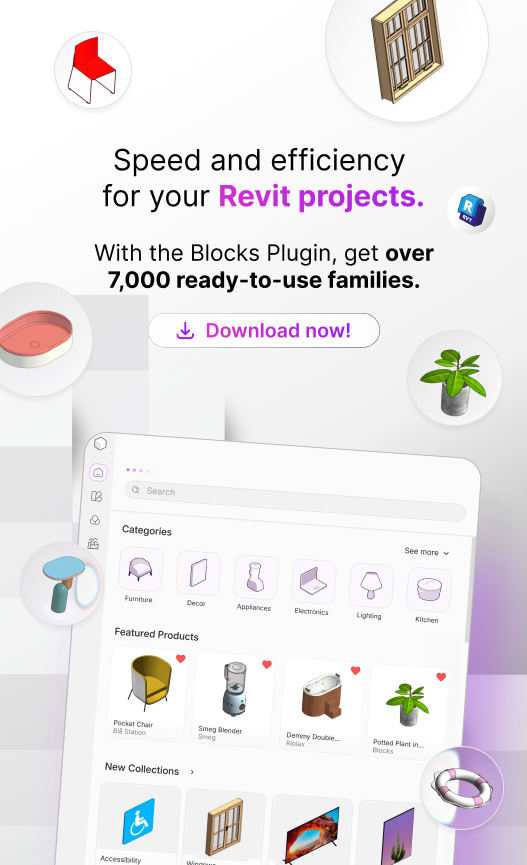
The Blocks Plugin addresses this directly inside Revit, with more than 9,000 parametric families from over 1,000 real manufacturers. Each family includes configured materials and render-ready textures and can be placed with a single click.
With the Teams feature included in the Premium plan, you can standardize the library across your organization and reduce repetitive work for modelers, leaving more time for coordination and quality control. With 25 new families added every week, the catalog also continues to grow.
Download the plugin for free and try it in practice, or explore the available plans to unlock the complete library for your team.

Frequently Asked Questions about BIM Managers
What are the main digital tools for a BIM Manager in the United States?
Autodesk Revit is one of the most widely used BIM authoring tools in the United States. Navisworks and Solibri are commonly used for model coordination and clash detection, while CDE platforms such as Autodesk Construction Cloud and Trimble Connect support file management, model sharing, and version control. On complex projects, automation tools such as Dynamo can streamline repetitive tasks and apply workflows at scale.
What is the job description of a BIM Manager in the construction industry?
A BIM Manager leads BIM implementation within an organization. They define standards and workflows, develop and maintain BIM Execution Plans (BEP), establish the Common Data Environment, monitor model quality, train project teams, and connect BIM processes with the company’s schedule, cost, and quality goals.
How should companies hire a BIM Manager for construction projects?
Before posting the position, determine whether the company needs a strategic BIM Manager or a project-level BIM Coordinator. Look for hands-on project experience, proficiency in Revit and coordination workflows, familiarity with relevant standards, and strong leadership skills. Ask candidates to share examples of BIM Execution Plans, standards, or workflows they have implemented, since these provide a clearer picture of their practical experience.
Where can professionals find BIM Manager jobs at major construction companies?
LinkedIn and Indeed lists a large number of BIM Manager and BIM/VDC Manager positions across the United States. . Candidates should also monitor company career pages, professional associations, and BIM or VDC communities, where opportunities may circulate before they are widely advertised.
What types of companies provide specialized BIM management services in the United States?
The U.S. market includes BIM and VDC consulting firms, architecture and engineering companies with dedicated digital-practice teams, and technology providers serving the AEC industry. Many offer implementation consulting, training, standard development, and outsourced coordination. When selecting a provider, evaluate its project experience, knowledge of relevant standards, and familiarity with your project type.
Which certifications are most relevant for BIM management professionals?
Relevant credentials include Autodesk Certified Professional in Revit, which demonstrates proficiency in a leading BIM authoring platform, and buildingSMART Professional Certification, which validates knowledge of openBIM principles and workflows. BIM certificate programs and graduate-level education in construction management, digital delivery, or VDC can further strengthen the qualifications of professionals who want to lead multidisciplinary teams.
Where can professionals find BIM Manager training and graduate programs?
In the United States, institutions such as Arizona State University, Michigan State University, the University of Washington, and Purdue University offer degree programs or BIM certificates that cover BIM implementation, coordination, model-based delivery, and virtual design and construction. Professionals who are just getting started can begin with Revit and model-coordination courses before pursuing a more advanced certificate or degree.
Conclusion
By now, you should have a clearer understanding of what a BIM Manager does. The next step is to keep expanding both your technical knowledge and your management skills.
Today, having a BIM Manager is no longer optional for a company. It has become a necessity.
As more public construction projects adopt BIM workflows, understanding the methodology is essential for anyone looking to build a solid career in the field.
Pursuing this career today means entering a market with significant room for growth in the years ahead.
If you found this content helpful, keep following the Blocks blog for more guides on BIM, Revit, architecture, interior design, and the day-to-day work of design professionals.