
The last decade has been a breakout moment for the minimalist movement, which went mainstream like never before..
While interest has surged since 2020, minimalist architecture has been around since the 20th century.
Some aspects have evolved, but the core idea remains the same: fewer pieces, neutral colors, and strategically placed curves.
In this article, Blocks unpacks what minimalist architecture is, where it comes from, its defining traits, and how to put it into practice. Let’s dive in.
So, let ‘s dive in. Enjoy your reading!
What is minimalism?
Minimalism, broadly, refers to 20th-century cultural and artistic movements defined by economy of means—the fewest elements to achieve the clearest result.
Because it’s such a broad concept, it can be applied to many areas,from personal lifestyle, to architecture.
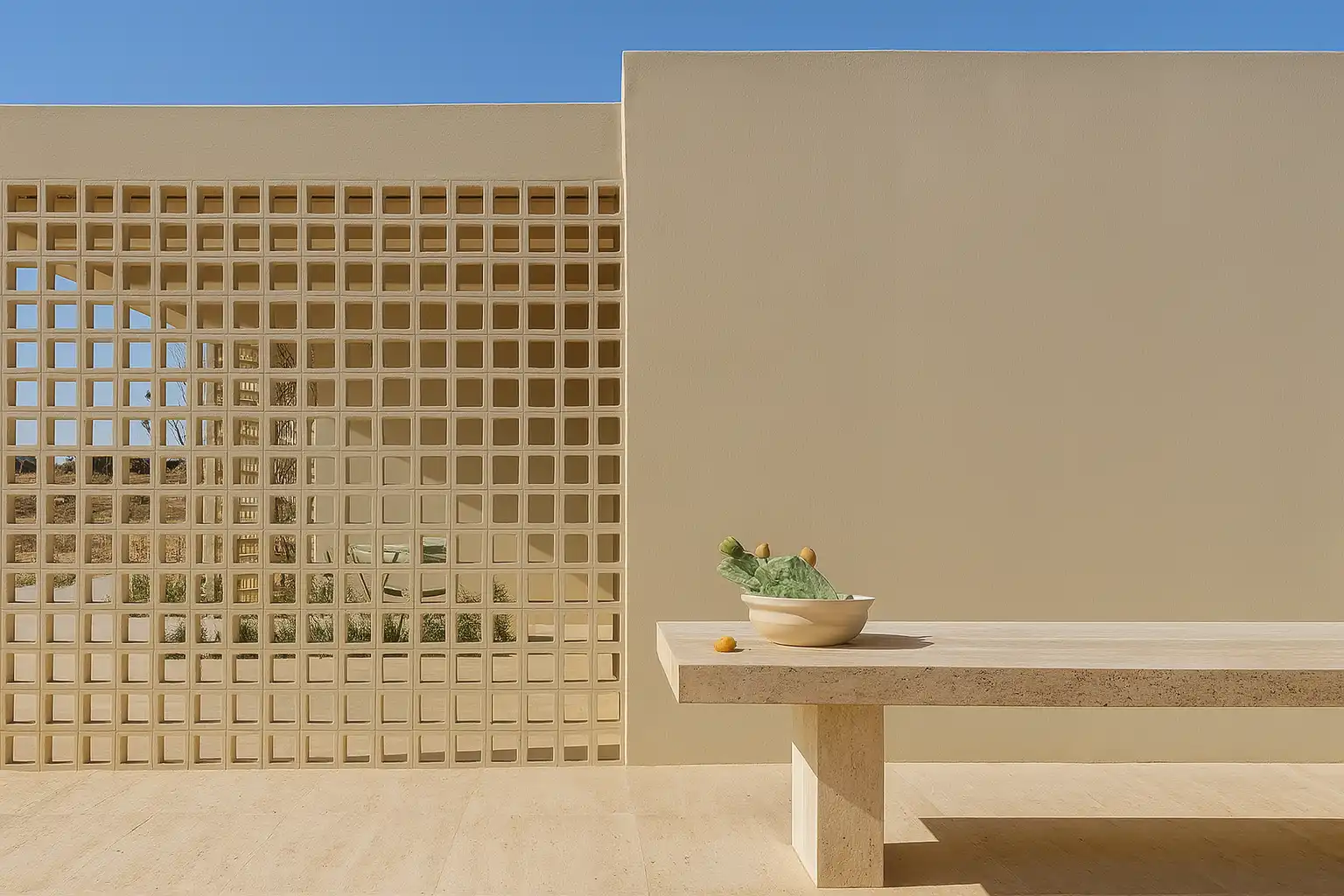
In architecture, minimalism privileges simple forms, restrained palettes,, and the deliberate absence of superfluous ornament.
Today, minimalism is as much a design language as a mindset, one that values intentionality and less excess.

Isadora Modesti
Coordenadora de Operações | Blocks®
“In minimalism, intentionality shapes every choice to create spaces that are both functional and clear. Start by defining the purpose of the room. Keep the palette light and neutral, adding depth with earthy tones as subtle accents in straight-lined furniture or purposeful curves. Plan circulation to ensure open, unobstructed flow, placing essential pieces strategically to highlight the value of empty space. Above all, embrace natural lightit expands, warms, and transforms the environment into one that feels light, clean, and serene.”
What is minimalist architecture?
Now that you understand the concept of minimalism, let’s define minimalist architecture.
At its core, minimalist architecture translates the principles of minimalism into the way we design and shape spaces.
It’s a style focused on aesthetic purity through the elimination of excess. That’s why it favors empty space and reduced decoration.
In minimalist architecture, every element is essential to shaping the space. Even the smallest details matter.
The result is clean, elegant architectural projects that bring a sense of tranquility and lightness to those who experience it.
Where did minimalism originate?
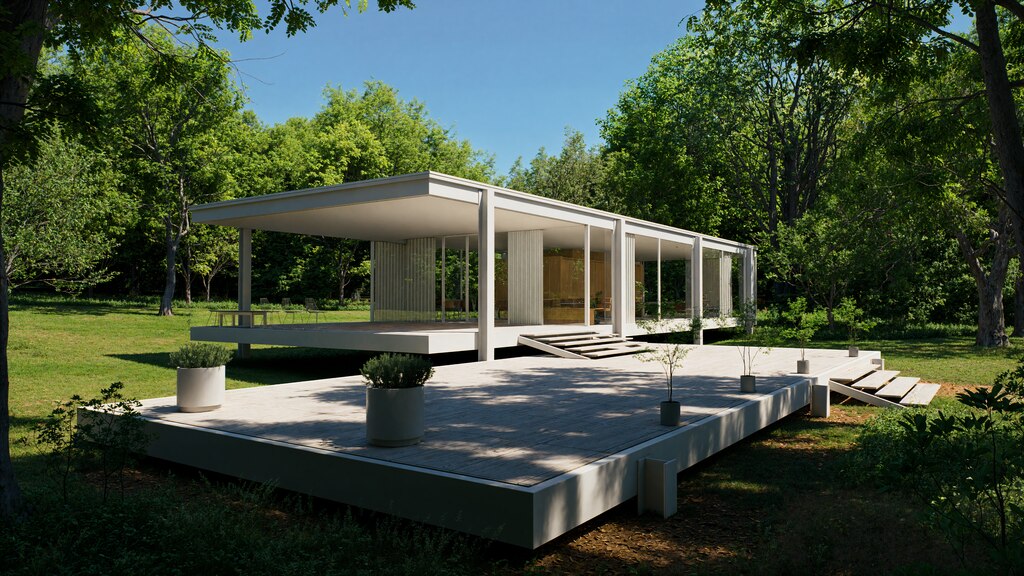
Minimalism first emerged as an artistic movement in the 1950s and 1960s.
In architecture, this style gained prominence in the postwar period, especially from the 1960s onward.
It was heavily influenced by early 20th-century European avant-garde movements such as De Stijl (Netherlands) and the Bauhaus School (Germany).
Both emphasized pure geometric forms, functionality, and the absence of unnecessary ornamentation.
Traditional Japanese culture also played an important role, inspiring minimalism through its philosophy of eliminating the excess and celebrating the essence of materials.
A phrase that defines both minimalism and minimalist architecture is “less is more”, immortalized in 1947 by architect Ludwig Mies van der Rohe.
Who are the leading minimalist architects?
Many architects have left their mark on the development of minimalist architecture, but the movement’s precursor was Dutch architect Gerrit Rietveld.
One of his most iconic works, the Schröder House, is considered the first major milestone of the minimalist movement.
Other notable architects include:
- Ludwig Mies van der Rohe: His landmark works, such as the Farnsworth House, explore glass and steel in light, transparent compositions.
- Tadao Ando: Japanese architect known for his expressive use of exposed concrete and natural light, especially in the Church of the Light in Osaka.
- Oscar Niemeyer: The Brazilian modernist who introduced a sense of structural lightness to Brazilian Architecture. Though renowned for his curves, several of his works reveal a minimalist approach to structure.
- Paulo Mendes da Rocha: Another Brazilian architect, responsible for the MuBE (1995) in São Paulo, which combines brutalism with formal simplicity.
- Lina Bo Bardi: Italian-Brazilian architect who designed MASP and the Glass House, redefining space through simplicity and transparency.
- John Pawson: Contemporary British architect, renowned for residences and commercial projects that celebrate emptiness and precise proportions.
Not all of these architects are strictly minimalist, but their works reflect minimalist touches.
For example, Niemeyer in some Brasília projects and Lina Bo Bardi in her own residence, the Glass House.
What are the key characteristics of minimalist architecture?
To truly understand minimalist architecture, we need to go beyond the visual and grasp its defining features.
Minimalism is not just about having fewer things, it’s about giving importance to every element in a space.
Here are the main characteristics of minimalist architecture:
Pure geometric forms and straight lines
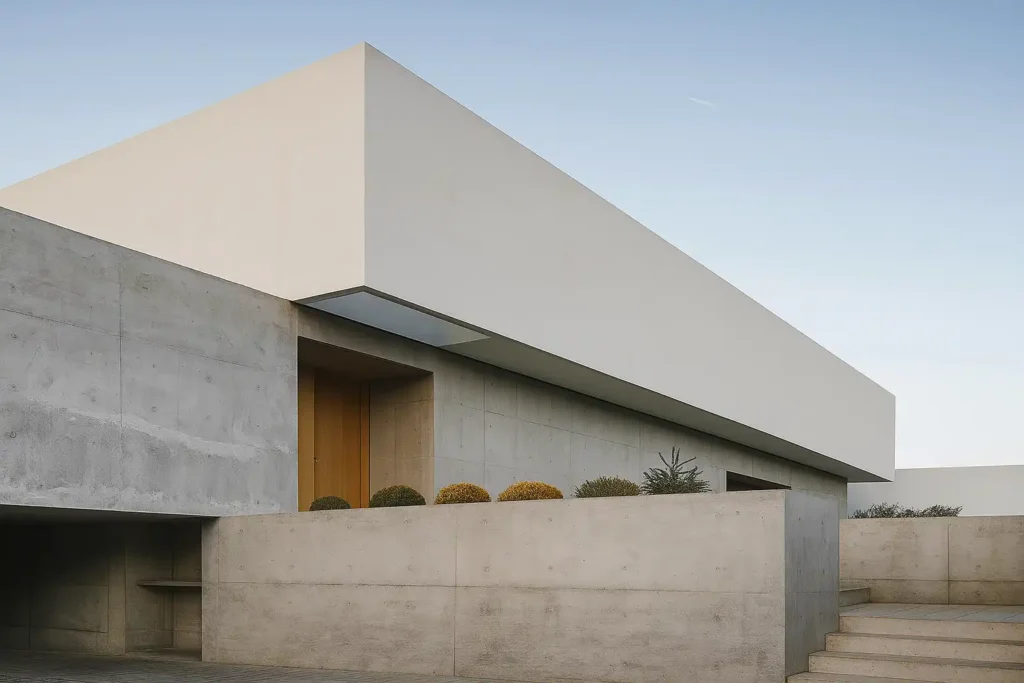
The foundation of minimalist architecture lies in straight lines and geometric forms.
Architects often choose cubes, rectangles, spheres, and clear linear forms to create a visual language.
Unlike other styles that rely on ornamentation, in minimalism the structure itself becomes the centerpiece.
Lines and shapes merge with the surroundings, becoming part of them.
Functionality above all
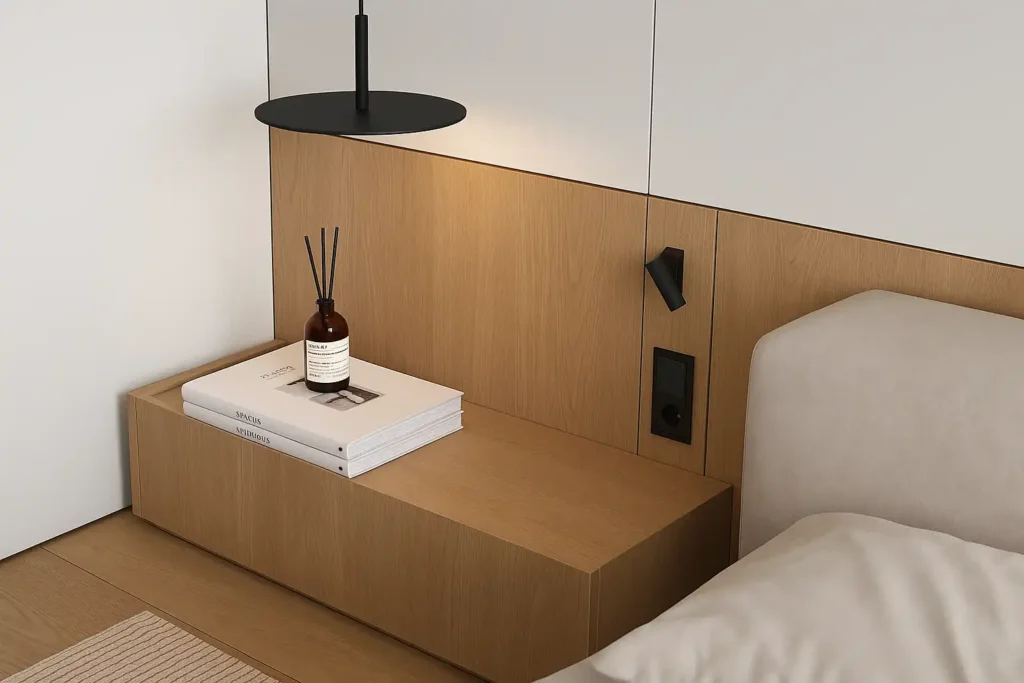
In minimalist architectural projects, every detail must serve a purpose.
The principle that form follows function is strictly applied, making aesthetics almost a natural consequence of the style.
Spaces are designed to optimize user routines, with intuitive circulation flows, “invisible” storage solutions, and adaptable layouts.
Thus, beyond beauty, a good minimalist project must first and foremost be functional.
In other words, beauty is not added,it emerges from the efficiency and logic of the minimalist floor plan.
Neutral and textured color palette
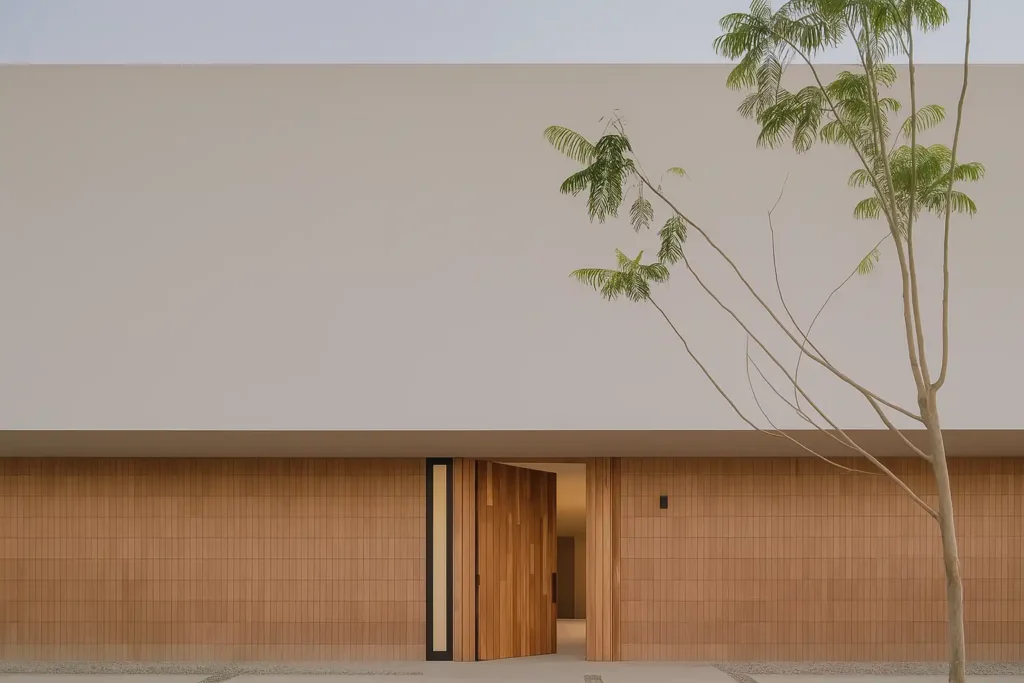
Another defining feature is the color palette, which usually leans on classics like white, off-white, black, beige, and other neutral tones.
White, in particular, is highly valued for its ability to reflect light and unify the entire space.
Minimalism also embraces textures: the roughness of concrete, the warmth of natural wood, the softness of polished walls.
Unlike other styles, minimalist architecture relies on subtle tones and textures to create refined, comfortable environments.
Emphasis on natural light
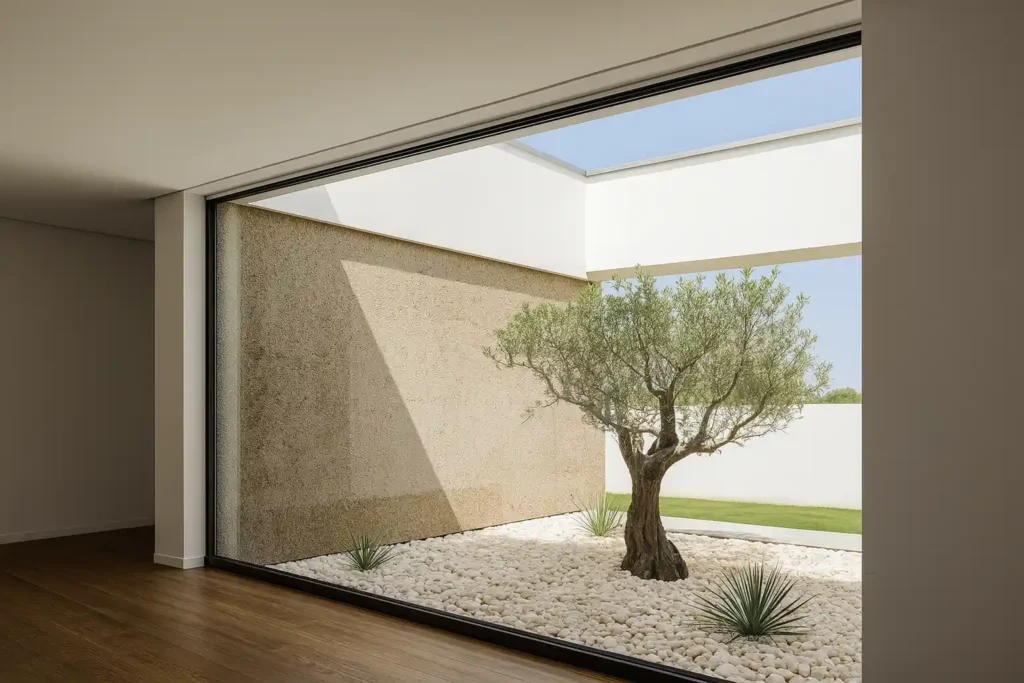
Natural light is also fundamental in minimalist architecture.
Daylight has the power to sculpt and define spaces, weaving through raw geometric forms and reflecting neutral colors.
Minimalist projects often feature large spans, floor-to-ceiling windows, and strategically placed skylights to maximize natural light.
By opening the structure to daylight, spaces become more sustainable, vibrant, and visually engaging.
Limited and honest use of materials
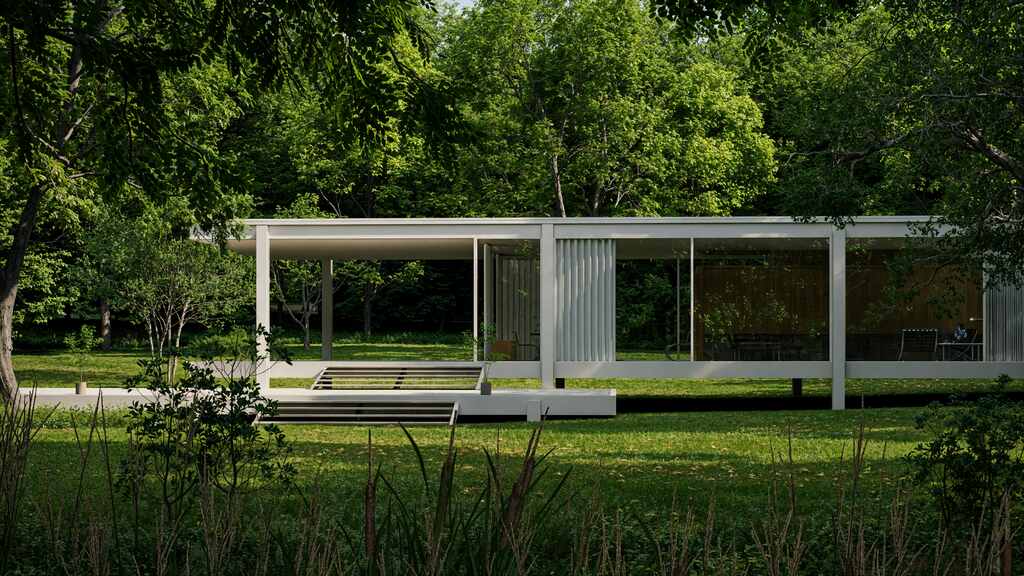
When Ludwig Mies van der Rohe said “less is more”, he was referring to the careful choice of materials.
In minimalist architecture, structural materials must always be of high quality, highlighting texture and integration with the environment.
Exposed concrete, steel, glass, stone, and natural wood are used honestly, without disguises or excessive finishes.
Integration with the outdoors
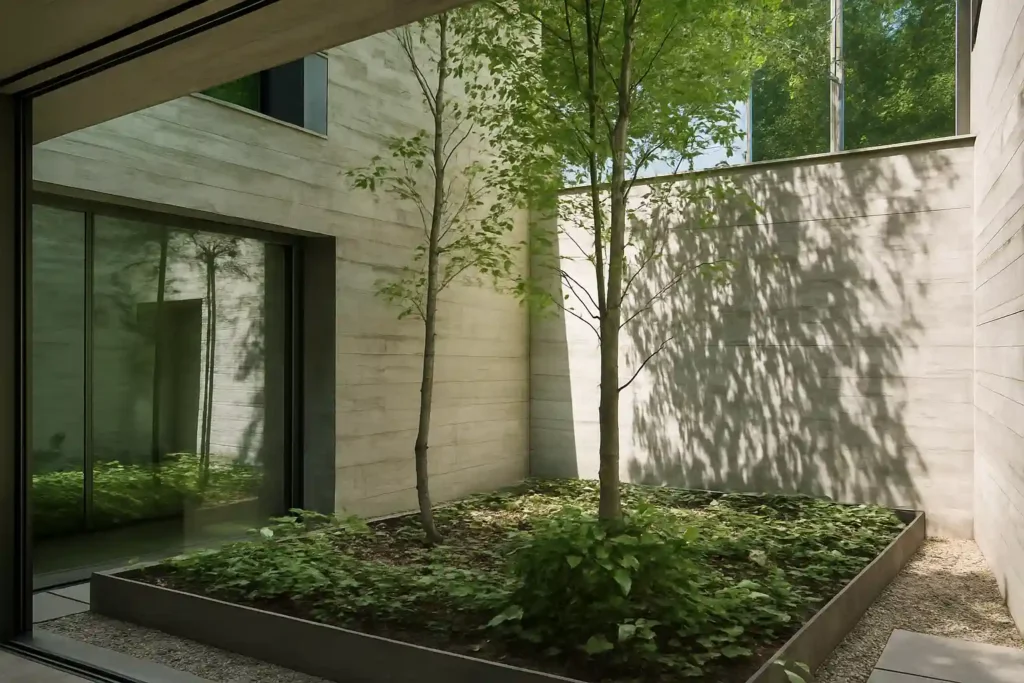
Integration with the exterior is a pillar of minimalist architecture. Imagine living where the living room and garden merge seamlessly.
This is the essence of minimalist design.
Instead of walls separating us from the outside world, it uses large glass panels, sliding doors that disappear, and even flooring materials that extend from indoors to outdoors.
The goal is simple: let sunlight flood in and bring the landscape indoors.
Open and clutter-free spaces
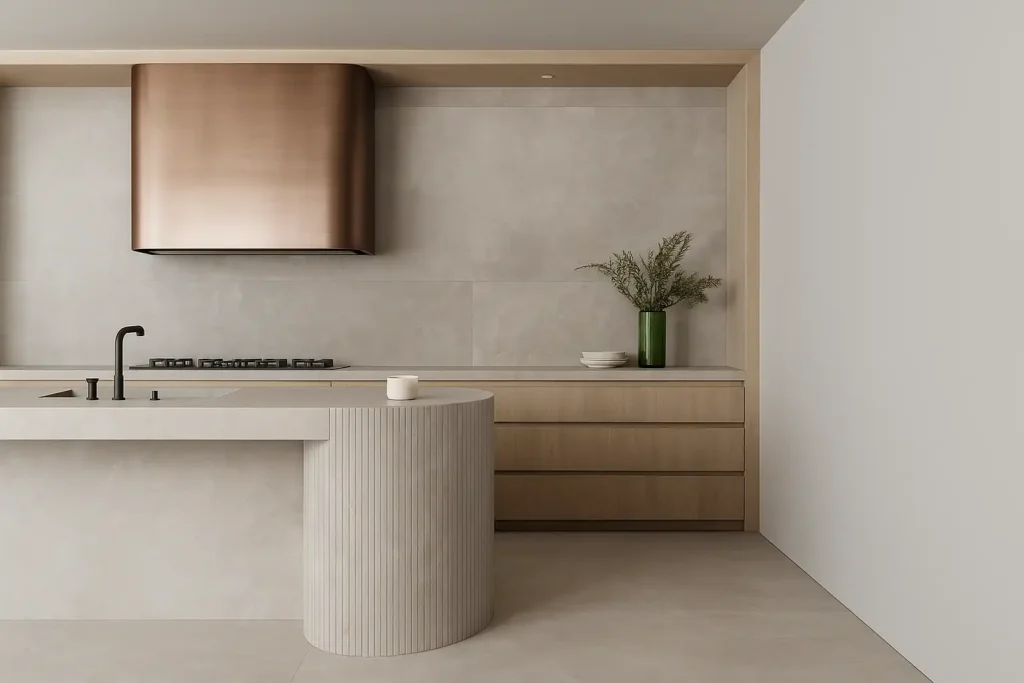
You know that feeling of relief when entering an organized room? Minimalism takes that very seriously.
The idea is to create open spaces with few walls and partitions. For example, the kitchen, dining room, and living room may merge into a single large area.
The key is integration and keeping only the essentials. Fewer furnishings, fewer decorative objects, more intelligent solutions.
How to apply minimalism in Revit projects
Now that you know the defining traits of minimalist architecture, it’s time to see how to apply them to your projects.
The goal is not to create empty spaces, but environments that breathe functionality and cohesion, without excessive ornaments or unnecessary furniture.
Here’s how:
- Blend functionality with simplicity: Every minimalist project starts with the principle that form follows function. Opt for smart solutions that combine utility and aesthetics—multifunctional furniture, built-in cabinets, and designs where every detail matters.
- Choose neutral palettes and natural materials: Use shades of white, gray, beige, and touches of black for a calm, sophisticated background. To avoid monotony, introduce textures with natural materials like wood, stone, and concrete, adding depth and richness.
- Leverage natural light: As mentioned, natural light is a foundation of minimalist architecture. Maximize it with large windows, sheer curtains, or light-colored blinds that offer privacy without blocking daylight.
- Show only the essentials: The essence of minimalism lies in carefully curating what remains. Be intentional: , keep only useful items or those with real sentimental value.
- Opt for simple furniture: Minimalist furniture is defined by straight lines, geometric clarity, and absence of excessive details. Invest in high-quality, timeless pieces—since in a space with fewer elements, each one has greater impact.
In short, the secret to applying minimalism is deeply understanding the concept.
You can’t just create an empty space and call it minimalist: you must consider structure, lines, layout, furniture, lighting, and more.
Minimalism at Blocks: download the free plugin!
Minimalism is trending, and Blocks is here for it!
The simpler the BIM object, the harder it seems to find online. But what if we told you your search is over?
With the Blocks Plugin, you’ll never waste hours hunting for the perfect minimalist family again. Here, you’ll find exactly what you need.
With a complete BIM library full of free objects, Blocks offers over 7,000 parametrized Revit families for you to design with minimalism in just a few clicks.
What are you waiting for? Start designing in Revit today—download the Blocks Plugin for free!

Conclusion
Minimalism will remain one of the strongest design trends in the years ahead. In a world overflowing with constant information, we need spaces that bring calm to the mind.
That is the essence of minimalist architecture: clean, functional spaces that focus on the essentials—without ever sacrificing beauty.
Minimalism is the new definition of chic, in which every element is deliberately considered, from structure to interiors.
Still, to design truly minimalist projects, you need a deep understanding of the concept, because in minimalism, every detail matters.
Still, to start designing minimalist projects, it’s crucial to deeply understand the concept, because in minimalism, every detail truly matters.
Enjoyed this article? Discover more on the Blocks blog, Instagram, TikTok, YouTube, and LinkedIn.