
Delivering a world-class hospitality project in BIM requires more than technical accuracy. It also requires a level of visual refinement that reflects the identity of the brand behind the development.
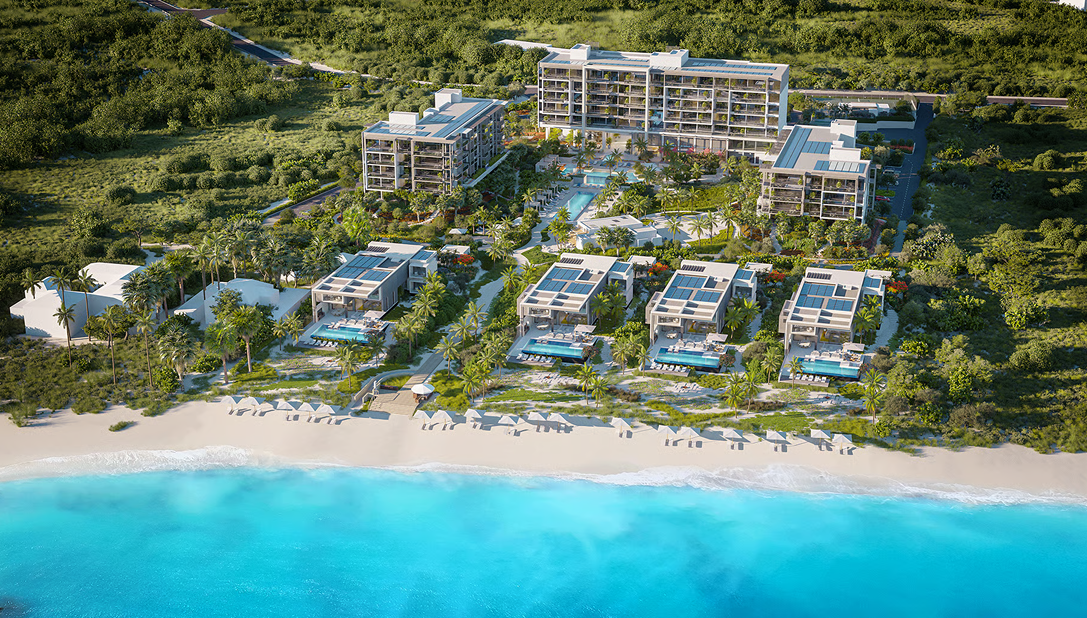
That was exactly the challenge DIOC Ingeniería faced when hired to develop the full architectural BIM model for Kempinski Grace Bay, a new luxury resort and residential complex on Grace Bay Beach in Providenciales, Turks & Caicos.
The project, developed by JTRE and operated by Kempinski Hotels, spans approximately 11 oceanfront acres under a low-density concept. It includes private villas, residences, restaurants, a beach club, spa, pools, sports courts, and a kids club, combining European hospitality standards with the distinctive character of the Caribbean.
To meet the demands of a project at this scale, DIOC adopted the Blocks plugin for Revit as its central tool for managing Revit families throughout the BIM workflow.
The challenges of BIM modeling for a luxury hospitality project
Before adopting Blocks, DIOC Ingeniería faced three core challenges that are common in complex hospitality developments:
1. Family creation and search
A significant portion of the team’s time was dedicated to searching for, adapting, or building Revit families from scratch, including furniture,lighting fixtures, doors, windows, sanitary elements, vegetation, leisure equipment, and decorative elements.
2. Visual and technical standardization
Aligning BIM coordination requirements with the aesthetic level expected of a luxury resort is no easy task. The team needed well-parameterized families with materials properly configured for both standard technical documentation views and high-quality renderings.
3. Demanding deadlines
With multiple project typologies, including suites, penthouses, oceanfront villas, lobby, restaurants, beach club, spa, sports areas, and kids club, the multidisciplinary coordination left little room for rework. Any inefficiency in family management would directly impact both the schedule and the quality of deliverables.
Why DIOC chose the Blocks Plugin for Revit?
DIOC integrated the Blocks plugin from the very beginning of the architectural modeling process, keeping it as the primary source of families throughout the entire BIM development of Kempinski Grace Bay. The decision was based on four strategic reasons:
- Agility in BIM modeling: drastically reducing the time spent searching for, downloading, testing, and creating families from scratch.
- Improved graphic quality: accessing families designed with architecture and interiors in mind, with materials, proportions, and details suitable for 3D views, study images, and final renderings.
- Library standardization: ensuring the entire team worked from the same set of parametric families, avoiding quality variations and compatibility issues between files.
- Focus on design decisions: freeing the team to focus on architectural decisions, coordination with other disciplines, and model refinement instead of repetitive tasks.
This approach follows the same logic as other digital innovation initiatives that combine Autodesk technologies with partner solutions to gain efficiency and improve governance in complex projects.
The solution: Blocks in practice at Kempinski Grace Bay
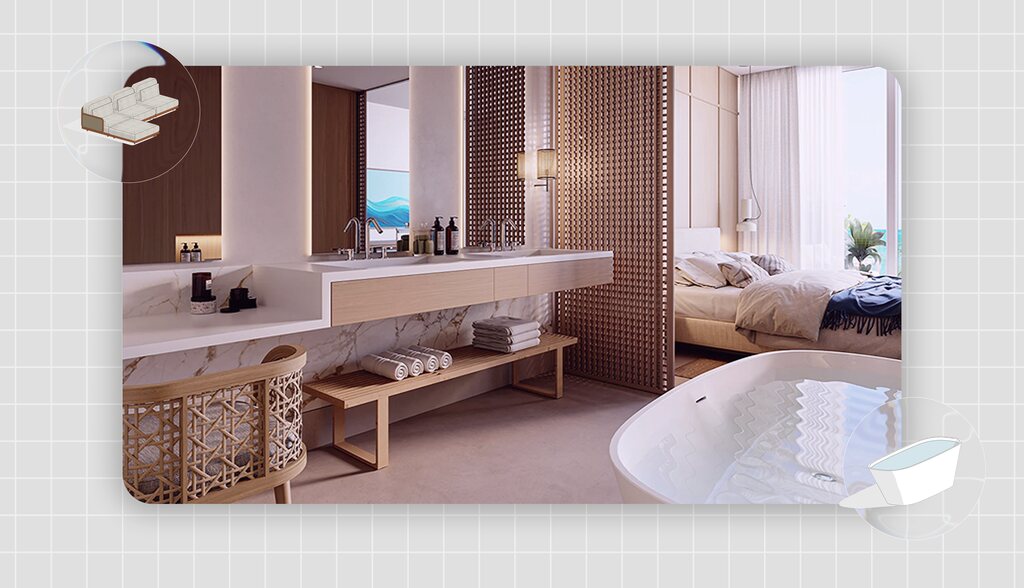
Blocks plugin was integrated directly into DIOC’s Revit environment, connecting the team to a broad library of parametric families optimized for architecture and interior design.
From furniture and lighting to vegetation and pool accessories, elements could be searched, tested, and inserted within the Revit interface.
Immediate access to high-quality families
Through Blocks, the DIOC team was able to quickly search for and insert families across every area of the resort:
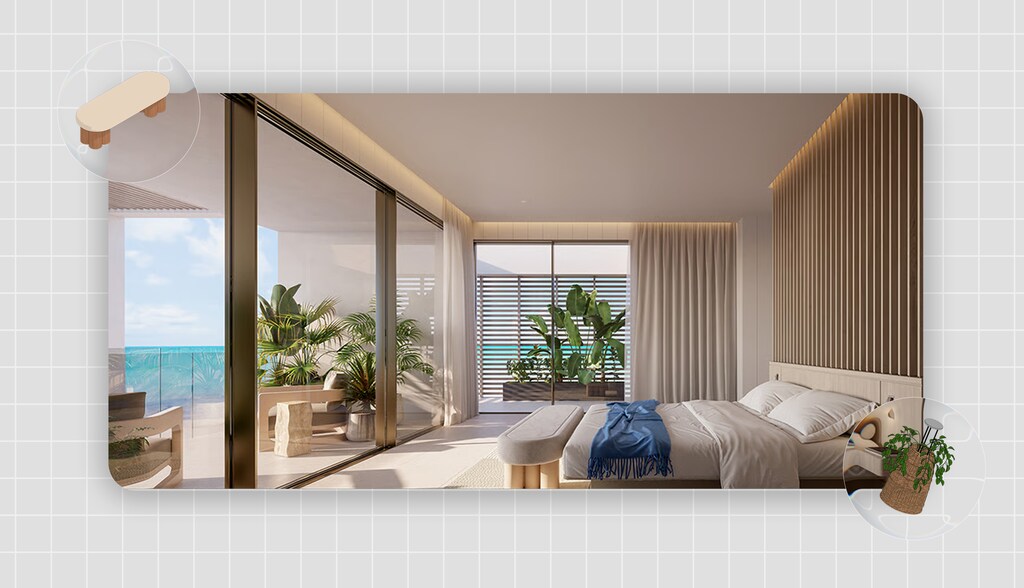
- Rooms and suites: beds, headboards, wardrobes, decorative lighting
- Living areas and lobby: sofas, armchairs, tables, light fixtures
- Restaurants and beach club: tables, chairs, counters, buffet elements
- Spa and wellness areas: specialized furniture, sanitary fixtures, and accessories
- Exteriors: sun loungers, umbrellas, pool furniture, vegetation
Using components aligned with real products helped bring the BIM model closer to the intended guest experience envisioned by the project’s architectural team.
Parametric and flexible families
The parametric nature of Blocks families allowed DIOC to quickly adjust dimensions, model variations, and materials at each stage. This allowed the team to test different layouts, spatial densities, and finish options without rebuilding elements from scratch at every iteration.
Smooth integration with the existing BIM workflow
Because Blocks runs directly inside Revit, there was no need to modify the team’s existing workflow. The plugin became the main source of architectural and interior components, reinforcing standardization across the entire resort model.
Focus on quality and fidelity
Knowing that the families offered reliable geometry, optimized performance, and materials ready for visualization gave DIOC the confidence to focus more on critical design decisions, coordination, and documentation, key aspects of an international hospitality development at this scale.
The impact: results delivered for DIOC and Kempinski Grace Bay
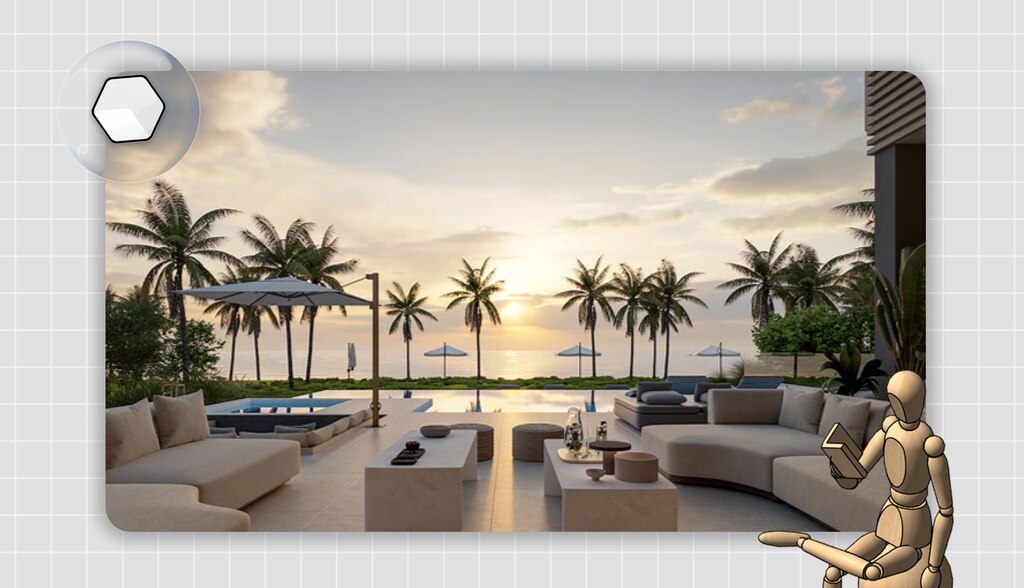
Adopting the Blocks plugin delivered clear and measurable benefits for the project:
- Many hours of work saved. Time traditionally spent creating and searching for families was redirected to higher value-added activities: interdisciplinary coordination, layout review, and architectural refinement.
- A more consistent and reliable BIM model. Standardizing families throughout the project reduced one-off adjustments, lowered the risk of graphic errors, and made it easier to update recurring elements across multiple units and common areas.
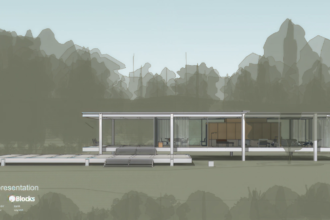
- Superior visual presentation. Blocks families contributed directly to a more elegant and coherent model, enabling the production of views, sections, presentation plans, and 3D images capable of clearly communicating the resort’s level of luxury to all stakeholders: developer, operator, investors, and local teams.
- Better foundation for renderings and client communication. The level of detail and material quality helped bring the BIM model closer to final marketing images and to Kempinski’s brand expectations, reinforcing the confidence of JTRE and other partners in the model developed by DIOC.
Taken together, these results show that the right family management strategy is not just a workflow decision, it directly shapes the quality, coherence, and credibility of the final BIM deliverable.
Ready to transform your BIM workflow?
Blocks is a platform specialized in parametric content for Autodesk Revit, designed for architecture and interior design workflows.
Through an intuitive plugin, Blocks provides a curated library of parametric elements, from optimized generic families to official manufacturer models, enabling architects, engineers, and designers to save time, improve the visual quality of their projects, and maintain more consistent and reliable BIM models.
This case study was developed in partnership with DIOC Ingeniería, an engineering and consulting company with strong expertise in BIM modeling and multidisciplinary coordination of complex projects.
Using Revit and the Autodesk ecosystem as their foundation, DIOC develops precise, coordinated models aligned with the demands of global clients, including the Kempinski Grace Bay resort in Providenciales, Turks & Caicos, a low-density luxury development combining European hospitality with the spirit of the Caribbean.
Want to see how other companies are transforming their BIM workflow with Blocks? Read our next case study: BlocksCase: BIM digitization and digital file management with Blocks.
Conclusion
The Kempinski Grace Bay case study is a clear example of how the right tools can make a real difference in complex BIM projects.
By integrating the Blocks plugin into their Revit workflow from day one, DIOC Ingeniería was able to save time, maintain visual consistency, and deliver a model that matched both the technical demands of multidisciplinary coordination and the high aesthetic standards of a luxury hospitality brand.
For BIM teams working on large-scale developments, having access to a reliable and well-curated family library is not a minor detail, it is a strategic advantage.