
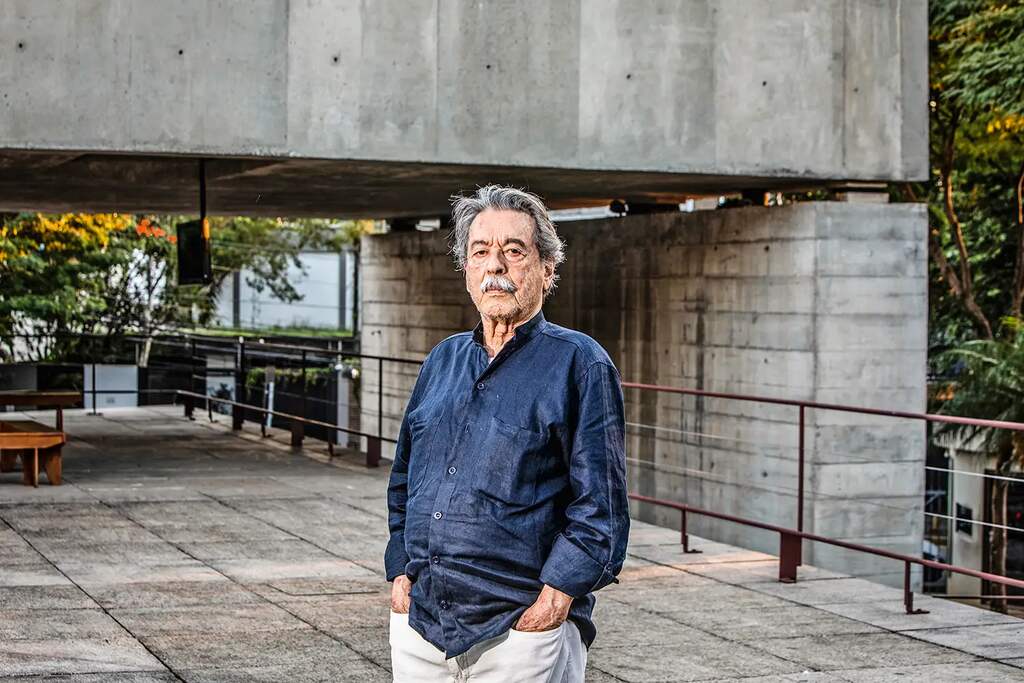
If you admire modernist architecture, you have certainly heard of Paulo Mendes da Rocha, one of the most important figures of Paulista brutalism.
Author of landmark projects such as the Brazilian Pavilion at Expo ’70, the Brazilian Museum of Sculpture (MuBE), and the Gymnasium of Clube Atlético Paulistano, Mendes da Rocha became one of the most influential architects of the 20th century.
He was part of the modernist generation led by João Vilanova Artigas, consolidating his reputation through bold exposed-concrete designs, such as the iconic Casa Butantã.
Throughout his career, Paulo received numerous prestigious awards, including the Pritzker Prize in 2006, often referred to as the “Nobel Prize of Architecture.”
In this article, we explore the history of this master of Brazilian brutalist architecture, revisit his most iconic works, and examine the influence he left on modern architecture.
Who was Paulo Mendes da Rocha, the Brazilian brutalist architect?
Paulo Mendes da Rocha was far more than an architect. He was a thinker of cities and a professor who constantly challenged conventional ideas.
Born in Vitória, Espírito Santo, in 1928, he graduated in architecture in São Paulo in the 1950s. At just 29 years old, he gained national recognition by winning the competition to design the Gymnasium of Clube Atlético Paulistano.
This early achievement already revealed his inclination toward daring structural solutions.
Mendes da Rocha was a key member of the so-called Paulista School of architecture, known for its expressive use of exposed concrete and strong structural lines, following the teachings of João Vilanova Artigas.
Alongside professional practice, he also pursued an academic career as a professor at the University of São Paulo (USP).
During Brazil’s military dictatorship, he was politically persecuted and banned from teaching, yet remained deeply engaged in debates on the social role of architecture, much like Lina Bo Bardi.
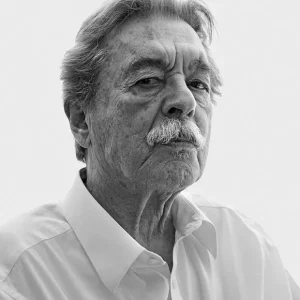
Paulo Mendes da Rocha
1928 – 2021
“Creating was never easy for me, contrary to what some people like to believe. Gaining speed in design does not mean it becomes easy, it means we have already lived through the difficulty and know it well.”
What is brutalist architecture?
To fully understand Paulo Mendes da Rocha’s work, it is essential to understand brutalist architecture.
Despite the name, brutalism has nothing to do with violence. The term comes from the French béton brut, meaning “raw concrete.”
This already reveals the essence of the movement: the expressive use of exposed concrete, without coatings or finishes that conceal its texture.
Brutalism gained prominence between the 1950s and 1970s as a branch of modern architecture and continues to strongly influence contemporary architectural projects.
Its main characteristics include monumental geometric forms, rectilinear volumes, and an emphasis on structure. Beauty lies in construction itself, in function, material honesty, and structural clarity, leaving little room for superfluous elements.
What is Paulo Mendes da Rocha 's most important architectural work?
Credits: Nelson Kon | Courtesy
When discussing Paulo Mendes da Rocha, it is difficult to single out a definitive work, given the richness and breadth of his architectural portfolio.
Still, many critics and historians agree that Casa Butantã,the house he designed for his own family,occupies a particularly important place in his career.
It is uncommon for an architect’s private residence to be regarded as a masterpiece. In this case, however, Casa Butantã stands almost as a manifesto of Mendes da Rocha’s ideas about a new way of living.
Built in exposed concrete and defined by extremely simple forms, the house features a radically open design.
Interior spaces flow continuously into one another, blurring the boundaries between private and shared areas.
This notion of spatial integration was one of the project’s greatest strengths. Not by coincidence, the jury of the Pritzker Prize highlighted this very idea decades later when recognizing his work.
In designing the house, Paulo deliberately eliminated any form of finish. There is no paint on the walls,raw concrete is the central element of the project.
Completed in 1964, the house was home to the architect and his family from the 1970s through the 1990s, until changes in family life, as his children grew older, led him to move out.
Today, Casa Butantã remains the property of Paulo Mendes da Rocha’s family, but it no longer functions as a residence nor as a museum open to the public. It is generally closed to regular visits, though it is occasionally used for academic research, photographic productions, documentaries, or restricted guided tours.
Major works by Paulo Mendes da Rocha
Throughout his career, Mendes da Rocha designed museums, institutional buildings, residences, and even furniture, such as the iconic Paulistano Chair.
Below are some of his most significant projects.
Brazilian Museum of Sculpture (1986) - MuBE
Credits: Nelson Kon | Courtesy
Located in São Paulo’s Jardins neighborhood, the Brazilian Museum of Sculpture, MuBE, is considered one of his masterpieces.
Designed in 1986 and completed in 1995, the museum was conceived with a radical idea: to have almost no building at all. Much of the museum is underground, preserving green space and functioning as a public plaza.
Above ground, visitors encounter a vast sculpture garden and a monumental concrete beam that frames the space like a portal. The landscape design was created by Roberto Burle Marx, perfectly integrated with the brutalist language.
Chapel of Saint Peter (1987)
In Campos do Jordão, a city known for its European aesthetic, stands an unexpected brutalist gem.
The Chapel of Saint Peter, built on the grounds of Palácio Boa Vista, is minimalist and striking: glass walls and a massive flat concrete slab define the structure.
Inside, the contemplative atmosphere is enhanced by a shallow reflecting pool covering the main floor, a powerful spatial gesture combining light, water, and structure.
Pinacoteca of São Paulo - Renovation (1998)
If Casa Butantã was his most personal work, the renovation of the Pinacoteca of São Paulo was his most emblematic intervention in architectural heritage.
Originally built in 1900, the museum underwent a complete transformation in the 1990s. Mendes da Rocha modernized the building while preserving its original character.
The result earned him the Mies van der Rohe Award in 2000 and remains a benchmark for contemporary interventions in historic buildings.
Casa Gerassi (1989)
In the late 1980s, Paulo Mendes da Rocha designed several urban houses, and Casa Gerassi is one of the most well-known works from this period.
Built in São Paulo around 1989, Casa Gerassi is a direct expression of what could be described as domestic brutalism.
With an exposed concrete façade and simple geometry, the house shows how Mendes da Rocha’s principles also apply at the scale of the family home.
An interesting fact is that the architect himself selected this project for his retrospective book published in 2000. This choice highlights how significant the residence was within his body of work.
Conceptually, Casa Gerassi recalls the functional logic of Casa Butantã, but adapted to a typical urban lot. Integrated spaces, exposed structure, and the absence of gratuitous decorative elements define the project.
Clube Atlético Paulistano Gymnasium (1961)
Let ‘s step back in time to discuss the Clube Atlético Paulistano Gymnasium, in São Paulo.
Conceived in the late 1950s in partnership with engineer João De Gennaro, this multipurpose sports gymnasium became an architectural phenomenon.
Paulo Mendes da Rocha designed an interior space free of central supports, ideal for the court and grandstands, combined with an appearance that was strikingly modern for its time.
It is no coincidence that, in 1961, when the project was completed, the Paulistano Gymnasium received an award at the São Paulo International Biennial and became a major reference in the architectural field.
It is worth noting that this work was delivered at the end of the 1950s. At the time, Paulo was only 29 years old and was already demonstrating his innovative vision of architecture.
Guaimbê Building (1965)
In the Jardins neighborhood of São Paulo, there is a building that is relatively modest in height yet striking in design: the Guaimbê Building.
Completed in the mid-1960s, the building was designed by Paulo Mendes da Rocha in collaboration with João De Gennaro and is frequently cited as a landmark of Paulista brutalist architecture.
Its narrow façade is entirely composed of exposed concrete and features a distinctive structural system, with floors articulated by prefabricated concrete elements.
On each level, a repetitive sequence is visible: a curved concrete sunshade above the main window and, directly below it, a triangular concrete planter, both projecting slightly from the façade.
In the São Paulo of the 1960s, dominated by glass-box buildings and the International Style, Guaimbê stands out for its more humanized brutalist approach.
Real estate agent Gabriela Cordeiro showcased an apartment for sale in the building on her TikTok profile. It is worth taking a look to see how the interiors are organized.
@gabrielacordeirog O apartamento no Ed. Guaimbê, do Paulo Mendes da Rocha! - 195m2 - 01 suíte com sauna seca e banheira de hidromassagem - 01 banheiro social completo - Ambientes sociais integrados - Área de serviço com banheiro e despensa - 01 vaga de garagem - Valor de venda: 5.000.000,00 - Valor do condomínio: 4.800,00 - IPTU mensal: 1.900,00 Dúvidas? Fala com a gente através do telefone (11) 95272-1929. #guaimbe #paulomendesdarocha #aptonojardinssp #haddocklobo ♬ som original - gabrielacordeirog
Bonus: Casa da Montanha
Créditos: GNT/Casa Brasileira
Finally, we couldn’t fail to mention one of Paulo Mendes da Rocha’s most recent, and lesser-known, works: Casa da Montanha.
The house is a countryside residence located in São Bento do Sapucaí, in the Serra da Mantiqueira, designed by Mendes da Rocha in partnership with architect Eduardo Colonelli.
Initially, Paulo envisioned a tall tower rising from the site, but the client was not enthusiastic about the proposal.
He then pursued a different approach: a long, linear house with a gabled roof, elevated above the ground on pillars, a solution that closely recalls Glass House by Lina Bo Bardi, particularly in its use of pilotis to adapt to the terrain.
The decision to lift the house off the ground was not merely aesthetic, but also practical. In the region, it is common to elevate buildings due to rugged topography and the presence of natural watercourses.
The exposed structure and the gabled roof give Casa da Montanha a distinct rustic-modern character.
Inside, the heart of the house is the kitchen, centered around a wood-burning stove, which Mendes da Rocha himself regarded as the main social gathering space.
He even designed a custom counter that allows people to sit around the stove and serve themselves directly from the pot.
One final detail stands out: the bathroom window, which is entirely unconventional. Instead of opening toward the horizon, it is deliberately oriented toward the ground.
Design like Paulo: download the Blocks plugin
It’s hard not to feel inspired by the architectural genius of Paulo Mendes da Rocha, right?
You may not design exactly like Paulo, but you can unlock your creative potential with the help of Blocks.
Our Revit plugin gives you access to a BIM library with over 7,000 families, designed to streamline your workflow and make everyday design tasks easier.
Every week, our BIM-specialized team releases new parametric family packages, built around real project needs.
Explore the full library and download the Blocks plugin for Revit today.

Conclusion
Paulo Mendes da Rocha showed us that architecture goes far beyond erecting buildings; it is a way of transforming how we live and interact with space.
His works, marked by exposed concrete and bold structural gestures, embody a deeply humanistic vision.
Mendes da Rocha leaves behind an outstanding body of Brazilian brutalist architecture, works that will remain timeless.
If you enjoyed this article, continue your journey into architecture, design, BIM, and Revit on the Blocks blog. And don’t forget to share it with others.