
During any construction project, adjustments and modifications to the original design are practically inevitable.
Last-minute changes, unexpected events on-site, or client-requested adaptations can alter the initial plans and layouts.
To properly record all these changes and ensure nothing is lost, there is a fundamental document known as As Built.
But what exactly is an As Built, what is it used for, and how does it work in practice? Blocks® will clarify all these questions in this article.
Let ‘s get started? Enjoy the read!
What is an As Built?
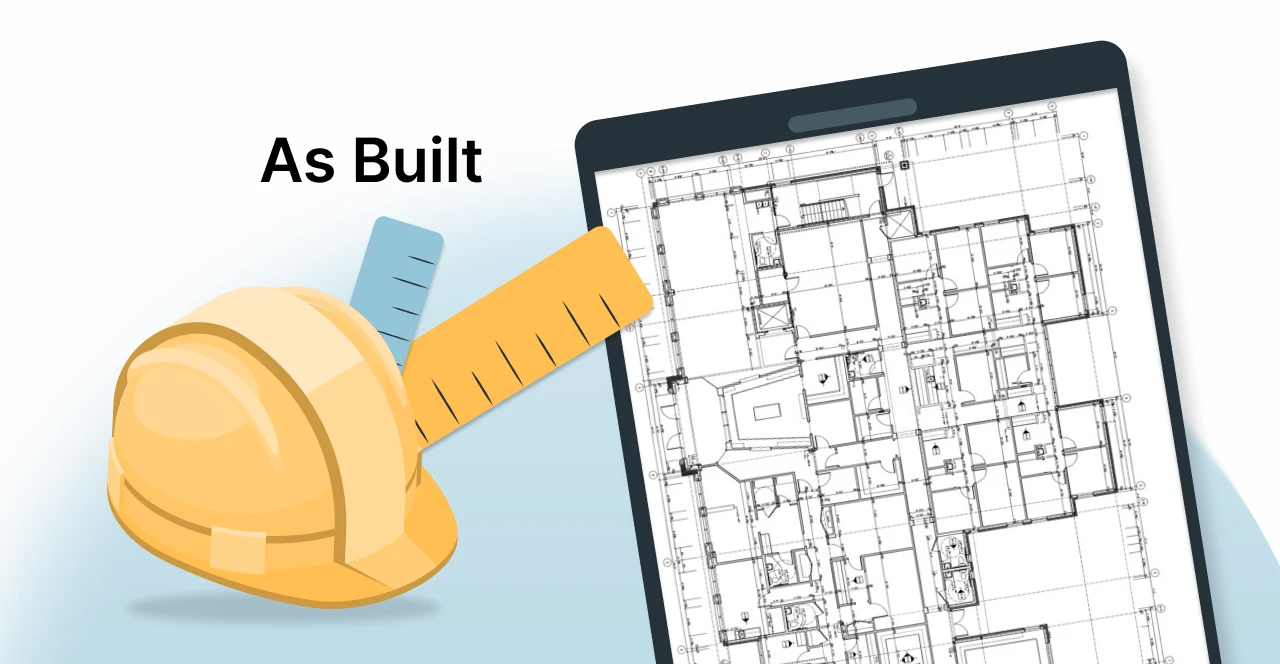
So, what exactly is an As Built? The As Built is a set of technical documents that shows exactly how the construction was actually executed, not just how it was originally planned.
It is the final version of the project, incorporating every modification made throughout the construction or renovation.
In an As Built project, architects and engineers record in floor plans, drawings, schematics, and descriptive reports all the changes that occurred during the construction.
These records include information such as: the real position of walls, partitions, doors, and windows, the routing of plumbing systems, the exact location of electrical wiring and outlets, installed HVAC systems and other elements.
In other words, the As Built is the complete documentation of the entire final construction, serving as a mirror of the finished project, able to be updated when necessary.
For example, if during execution a wall was moved, a structural column added, or an electrical network rerouted, all of this must be included in the As Built project.
In the end, the architect and engineer will have a complete technical dossier with all the real information of the project.

Isabela Guedes
Civil Engineer | Marketing Coordinator at Blocks®
“It is recommended to adopt an integrated workflow between field and office from the very beginning: use tablets or mobile BIM applications, such as BIM 360, to record each change on-site, photograph discrepancies immediately, and synchronize this data in real time. This ensures that the ‘as built’ project accurately reflects reality, reducing major document rework at the end of the project.”
Purpose of an As Built in a project
Knowing what an As Built is isn’t enough,you also need to understand its practical role within a project.
The As Built plays several key roles in the lifecycle of a construction project, all focused on ensuring transparency, safety, and efficiency after completion.
In general, it serves as an accurate, up-to-date record set of the executed project, working almost like an “owner’s manual” for the building as delivered.
To make it clearer, let’s explore the main benefits of an As Built documentation.
Complete and accurate project documentation
First and foremost, the As Built provides comprehensive and accurate records of the project.
Throughout construction, changes happen for many reasons—technical adjustments, scope changes, or even on-site improvisations.
All of these modifications are captured in the As Built, creating a set of drawings and documents that reflect exactly what was built.
In short, once the project is complete, the As Built shows the actual state of the building, without discrepancies—a critical requirement for construction.
Streamlined maintenance and future repairs
Another important purpose is simplifying maintenance and repair work in the future.
With updated drawings in hand, maintenance teams can easily locate embedded plumbing, electrical conduits, structural beams, and other “hidden” elements within the building.
This drastically reduces the risk of errors when drilling into walls or working on installed systems, preventing accidental damage.
For example, years later, if a pipe or electrical line needs repair, the As Built makes it easy to identify the exact routing of those systems. This accelerates the repair and avoids unnecessary rework.
Enhanced safety and reduced risk
The As Built also improves safety and reduces risks during future interventions.
With a detailed record of the project, the likelihood of accidents caused by a lack of information is much lower.
For instance, imagine starting a renovation without knowing exactly where electrical cables or gas lines run. The chances of a serious accident would be high.
Having the As Built eliminates this uncertainty, giving professionals a clear map of what’s behind walls and floors, helping preserve the integrity of the building.
Easier renovations and expansions
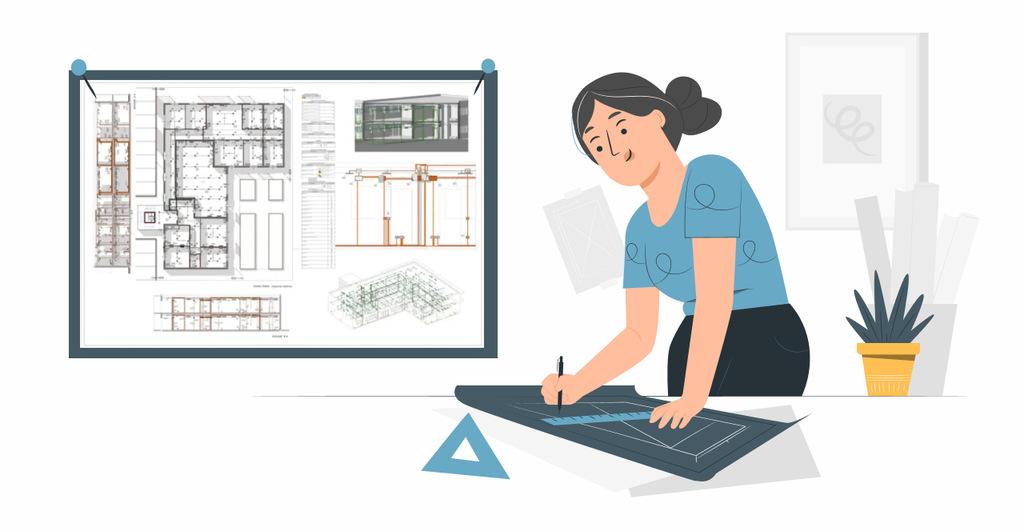
Having an As Built project makes renovations and expansions far simpler.
For architects and engineers designing modifications, having the building’s actual configuration as a starting point is a major advantage.
The As Built serves as a reliable foundation for new projects, allowing professionals to begin planning with an accurate understanding of existing conditions.
This makes renovation processes faster, more precise, and more cost-effective, minimizing surprises and incompatibilities between design and construction.
Compliance with codes and legal requirements

Finally, the As Built helps ensure compliance with codes and regulatory requirements.
In many cases, public agencies and regulatory bodies require “as built” drawings to issue permits or licenses.
This means having an As Built in place demonstrates proper documentation and shows that the construction was executed according to current regulations.
For instance, in the event of audits or technical inspections, the As Built acts as documentary proof that the building meets all safety and compliance standards.
Key elements to include in an As Built
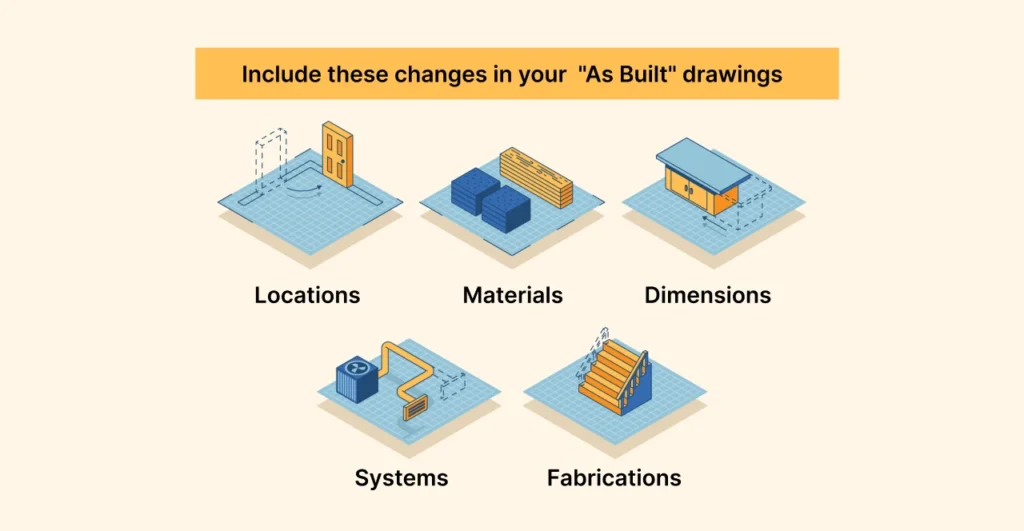
To make sure your “As Built” drawings fully complete and functional, it is essential to record all changes made relative to the original project in the following areas:
- Locations: note every change in the position of doors, window frames, plumbing points, carpentry, or any other essential element.
- Materials: record any variations in materials used whenever substitutions or adjustments occur compared to the initial plan.
- Dimensions: document all modifications in the measurements of any construction component, ensuring millimetric accuracy.
- Installations: list specific changes in system installations – HVAC, electrical, windows, automation, basically anything involving assembly or integration of components.
- Prefabricated elements: record any updates to prefabricated components, such as columns, beams, railings, and other structural or decorative elements.
- Important note: in addition to the drawings, include supporting documents—field notes, reports, photographs, or even satellite images—to enhance the descriptive report and provide visual context to the final outcome.
By keeping these records well-organized, you ensure the As Built faithfully reflects what was executed on-site, serving as a dependable guide for future maintenance, renovations, or compliance inspections.
Why is it so important in a project?
It’s undeniable that the As Built is critical in any construction project.
We’re not talking about an optional document, but an indispensable element that guarantees both quality and safety.
From a safety perspective, its importance is unquestionable. Imagine firefighters needing to access the main water shutoff valve during an emergency and being unable to locate it. Any delay in critical situations can have severe consequences.
From a financial standpoint, the investment in producing an As Built pays off quickly. The costs of rework or trial-and-error interventions are far higher than documenting changes during construction.
It is also essential for knowledge management. The construction team won’t be around forever.
The As Built preserves knowledge about the construction, enabling future facility managers, owners, and maintenance teams to fully understand the structure.
Types of As Built projects
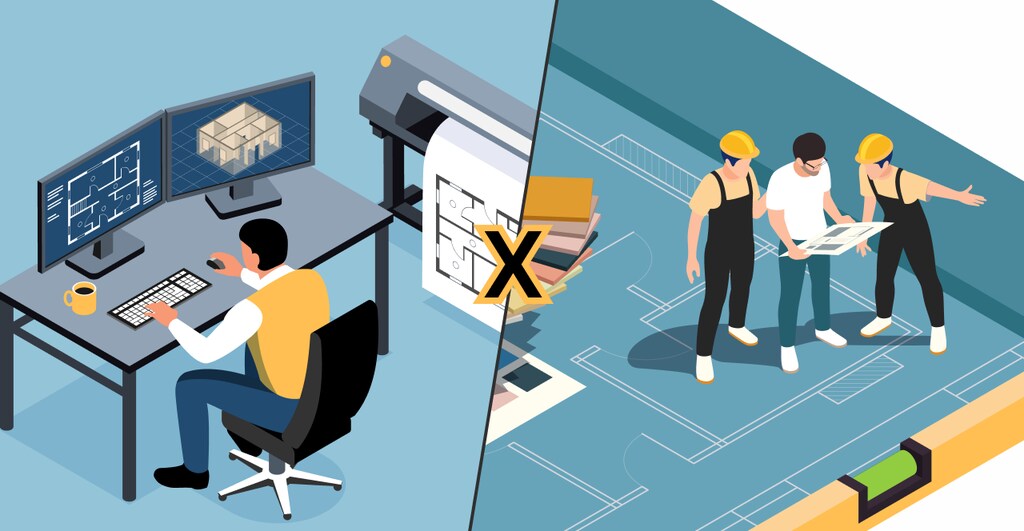
The As Built applies to all areas of a project, from architecture to building systems.
There are architectural As Built documents, electrical As Built, plumbing As Built, HVAC As Built, and many others.
Put simply, almost every discipline within the AEC (Architecture, Engineering, and Construction) industry can generate its own As Built records.
Across each discipline, the principle is the same: faithfully documenting how that system was actually constructed, incorporating all changes made during the process.
In addition to categorizing by discipline, we can also think about types of As Built projects based on the stage of construction in which they are produced.
Let’s explore the main phases of an As Built project.
Execution phases
During the execution phase, the As Built is developed in parallel with the progress of the construction.
As the work advances, any changes to the original design are identified and documented by the responsible professionals.
Engineers, architects, or site technicians carefully track the job site for discrepancies: if a wall was moved, materials were swapped, or an outlet was relocated, everything must be recorded.
Completion phase
In the completion phase, the goal is to consolidate all the information and produce the final “as constructed” documentation for delivery.
Once the project is finished,or nearing completion,professionals carry out a full survey of the building. They compare the initial blueprints with the actual construction to ensure accuracy..
This is the time to verify every detail: measure all rooms to confirm final dimensions, check whether all previously identified changes were properly recorded, and document any last-minute adjustments.
Essentially, it’s a thorough review of the entire project, ensuring that the As Built reflects 100% of reality.
At this stage, it’s common to use advanced technologies to increase accuracy and efficiency, such as 3D laser scanning, drones, and of course, BIM software.
With the collected data, the final documentation is updated and delivered.
How is the As Built created?
Now that we’ve covered the phases and characteristics of an As Built, let’s break down how an As Built is created step by step, from a practical standpoint.
Preparing an As Built project requires careful, multidisciplinary work, involving both field and office activities.
In general, the process can be divided into a few main steps carried out by the designated architects, engineers, or technicians:
- Gather and review the original documentation: Before going on-site, professionals must collect all approved plans, drawings, and specifications, including architectural, structural, electrical, plumbing, and other disciplines.
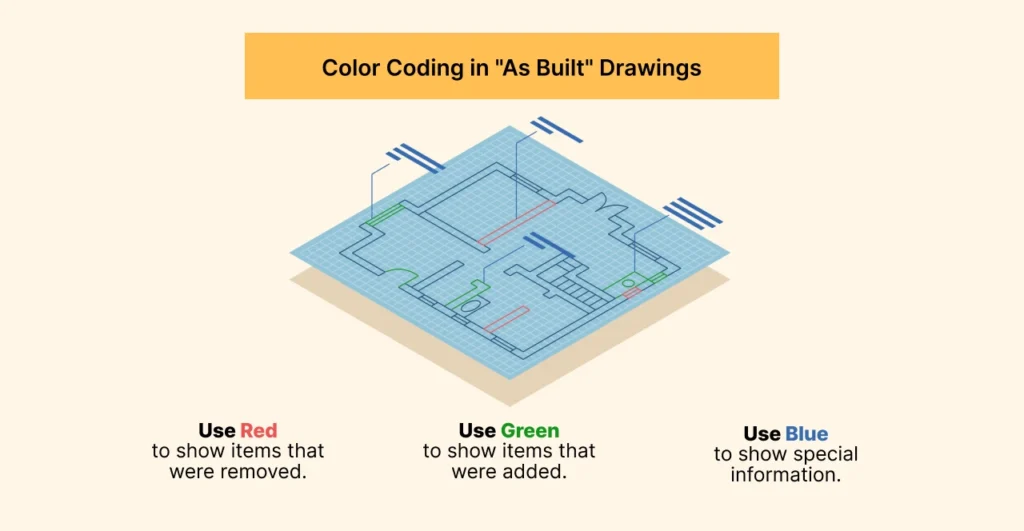
- Color code: “as-built” drawings follow a standard legend — red for excluded items, green for added items, and blue for special information.
- On-site survey: Next comes the fieldwork—technical visits to the completed project to verify, measure, and record every space and system in place.
- Document discrepancies: It’s essential to log all differences. To ensure accuracy, take dated photographs of every change, attach them to the plans, and add detailed notes about dimensions, replaced materials, relocated elements, or added/removed installations.
- Update technical drawings: After the site survey, professionals update the original drawings on their computers, correcting and adjusting them with the newly collected data.
- Comprehensive technical review: Before finalizing, a full review of the updated documents is crucial. Often, this step is done by another professional or project coordinator, comparing the As Built drawings against field notes to make sure nothing was overlooked.
It’s worth highlighting that modern technology has made preparing As Built documentation faster and easier.
Today, mobile apps allow professionals to input survey data directly into 3D models on-site, for example.
The use of BIM models, in particular, offers the advantage of automatically updating every derived view—sections, elevations, and plans—when a single element in the 3D model is modified.
Looking for more efficiency in your projects? Count on Blocks!
Want more speed and flexibility when developing your architecture and engineering projects? Count on Blocks!
Our Revit plugin offers thousands of high-quality parametric BIM families, ready to use.
With this tool, you save valuable time in the modeling phase, since you can insert components and materials into your projects with just a few clicks.
We’re constantly updating and enriching our BIM library with furniture, equipment, lighting fixtures, and many other essentials for your projects.
Beyond speeding up your workflow, you’ll always have reliable, optimized models at your fingertips, developed by a specialized BIM team.
Take your projects to the next level of efficiency with Blocks. Download our plugin for free and start designing faster today!
Conclusion
So, is it clear now what an As Built is, what it’s used for, and how it works? We hope so!
The As Built is essentially the faithful record set of a construction project as delivered, incorporating all changes made to the original design.
In short, the As Built has become an indispensable tool in the lifecycle of construction projects.
Most architects and engineers who have a reliable As Built are able to move forward with future interventions far more safely.
That’s why you should never underestimate the value of a well-executed As Built—it’s the final “link” between design and reality.
Enjoyed this article? For more content like this, visit the Blocks blog!