

“Oscar Niemeyer was more than just a master of architecture:he was a genius,” says Rodrigo Queiroz, professor and researcher of Architecture at FAU-SP.
Oscar Niemeyer designed some of the most iconic works in Brazil, including the Copan Building, the National Congress, the Pampulha Architectural Complex, and many others.
As one of the leading figures of modern Brazilian architecture, his career and projects hold immense importance in the country’s history.
Let’s take a closer look at Niemeyer’s life and works. Stay with Blocks® and enjoy the read!
Who was Oscar Niemeyer?
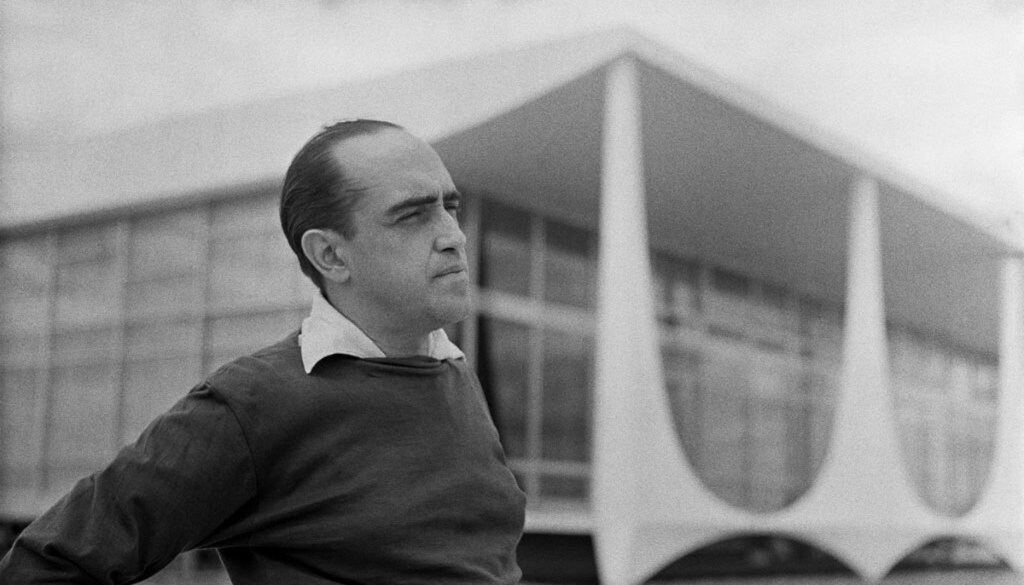
Oscar Ribeiro de Almeida Niemeyer Soares Filho, born December 15, 1907, in Rio de Janeiro, was a Brazilian architect widely regarded as the father of modernist architecture.
Niemeyer, as many know him, was the visionary who gave shape to the dream of Brasília, Brazil’s new capital.
However, his legacy goes far beyond Brasília’s architectural design. He also created national and international landmarks that still feel bold and innovative today.
After graduating from the National School of Fine Arts at the Federal University of Rio de Janeiro, Niemeyer immersed himself in modern architecture, deeply influenced by the ideas of Le Corbusier.
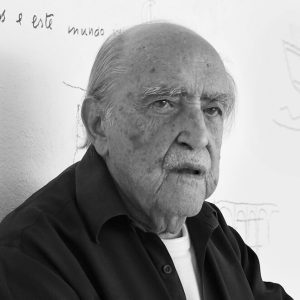
Oscar Niemeyer
1907 – 2012
“It is not the right angle that attracts me, nor the straight line, hard, inflexible, created by man. What attracts me is the free and sensual curve. The curve I find in the mountains of my country, in the winding course of its rivers, in the waves of the sea, in the clouds of the sky, in the body of the woman I love. The whole universe is made of curves—the curved universe of Einstein.”
New York World’s Fair
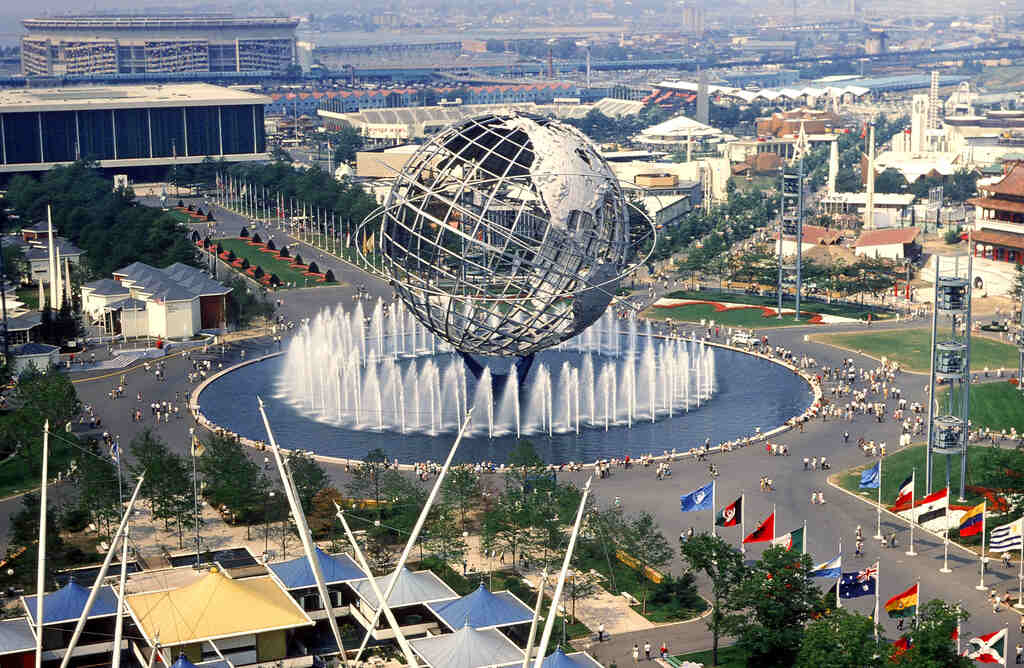
In 1938, Brazil’s Ministry of Labor launched a national competition to select the design for the Brazilian Pavilion at the 1939–40 New York World’s Fair.
In 1939, Niemeyer, together with Lúcio Costa, presented his ideas for the pavilion. Costa placed first and Niemeyer second.
After the results, Costa invited Niemeyer and the German urban planner Paul Lester Wiener to merge their ideas for the Brazilian Pavilion.
Oscar never imagined this project would transform the course of his career.
It was through this pavilion that Niemeyer gained international recognition, showcasing his modernist hallmark: sculptural curves and expressive use of water. Alongside Lúcio Costa, he moved away from the rigid rationalism of the time, introducing sinuous ramps and cut-out façades that captured the attention of critics and authorities.
His work was so impressive that New York’s mayor, Fiorello La Guardia, presented him with a key to the city.
The pavilion’s success led to major commissions for Niemeyer, including the Pampulha Complex (1940–45) and the Ministry of Education and Health (1947), in partnership with Le Corbusier.
The creation of a new capital for Brazil
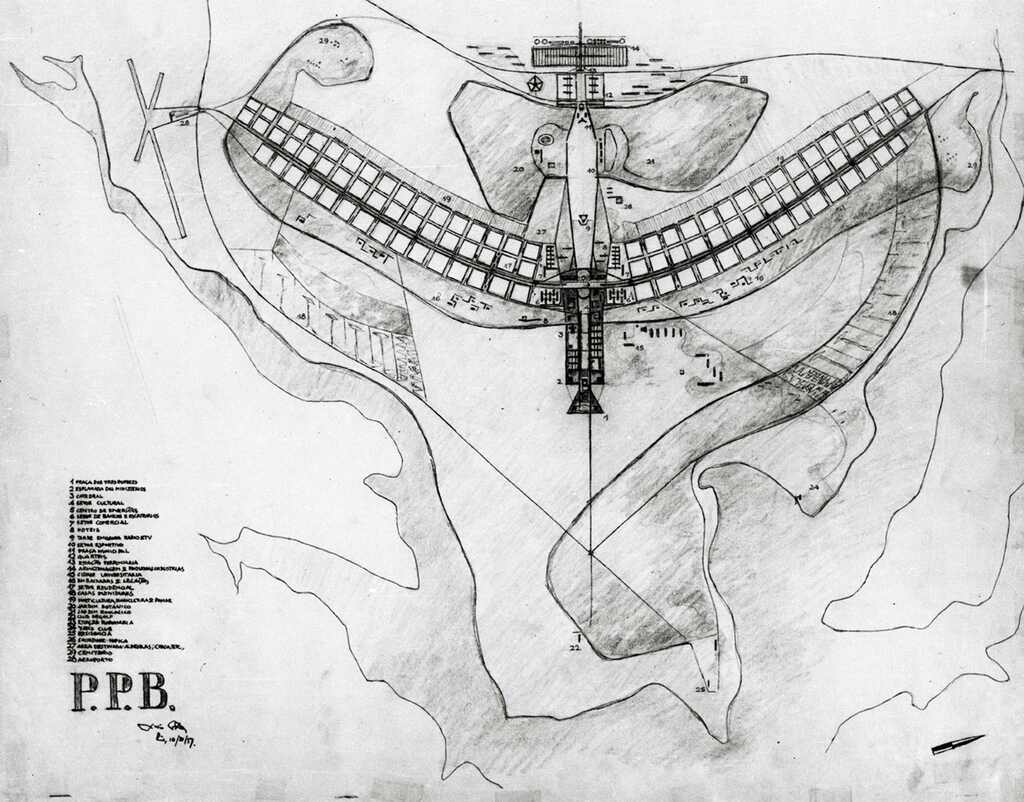
On September 19, 1956, a law established Novacap (Companhia Urbanizadora da Nova Capital), the company created to build Brazil ‘s new capital.
In 1957, Novacap formed its Department of Urbanism and Architecture under Niemeyer’s leadership, after he was personally invited by President Juscelino Kubitschek.
On March 12, 1957, the National Competition for Brasília’s Pilot Plan was launched. The jury, led by Israel Pinheiro (Novacap’s president) and composed of representatives including Niemeyer, the IAB, the Engineering Club, and foreign specialists, evaluated 26 proposals.
On March 16, 1957, the jury selected Lúcio Costa’s design as the winning Pilot Plan.
As chief urban planner, Costa nominated Niemeyer,already Novacap’s technical director,to take charge of designing the monumental buildings within the master plan.
Thus began Niemeyer ‘s work on Brasília, side by side with Lúcio Costa.
What are Oscar Niemeyer’s main works?
Niemeyer’s legacy is not limited to Brasília,he designed numerous historic landmarks that reshaped modern Brazilian architecture.
Let’s explore them together!
1. Ministry of Education and Health (Palácio Gustavo Capanema Building)
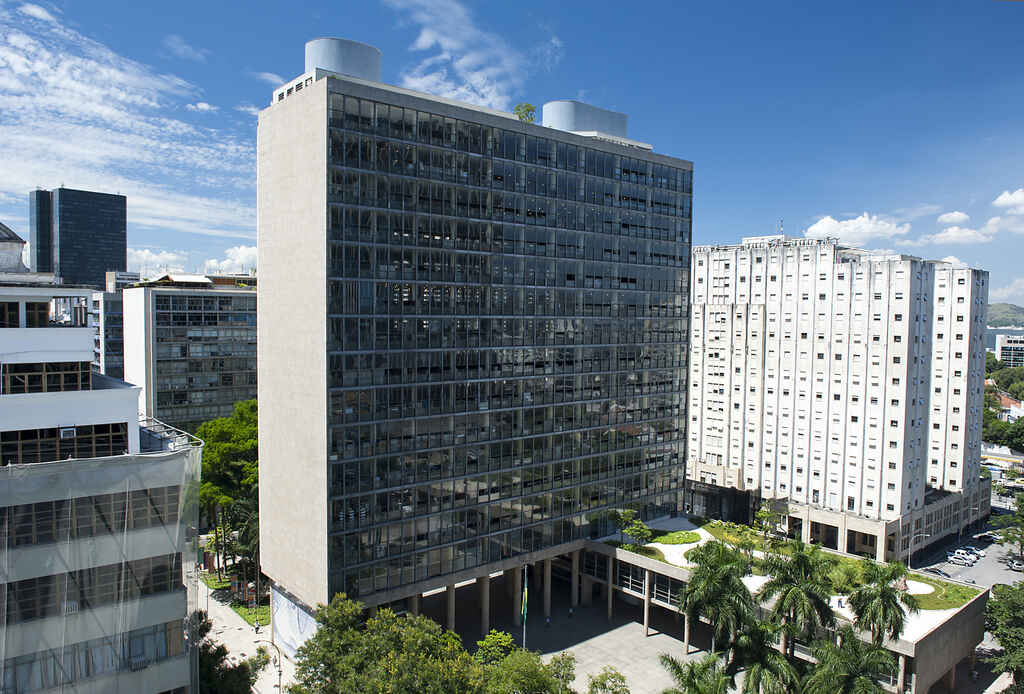
In the 1930s, Niemeyer was already showing how his architectural vision would redefine Brazilian modernism.
In 1936, he was invited by Minister Gustavo Capanema and Lúcio Costa to help design the new Ministry of Education and Health in Rio de Janeiro.
Although Costa initially led the project, Niemeyer joined the team and, after Le Corbusier’s departure, took over the design.
Niemeyer adapted Corbusian principles,pilotis, free façades, and brise-soleil panels,making them adjustable and integrating them seamlessly with Roberto Burle Marx’s landscape design.
Completed in 1943, the building, today known as the “Palácio Gustavo Capanema,” is considered the first major landmark of state-sponsored modernism in the world.
2. Brazilian Pavilion at the New York World’s Fair
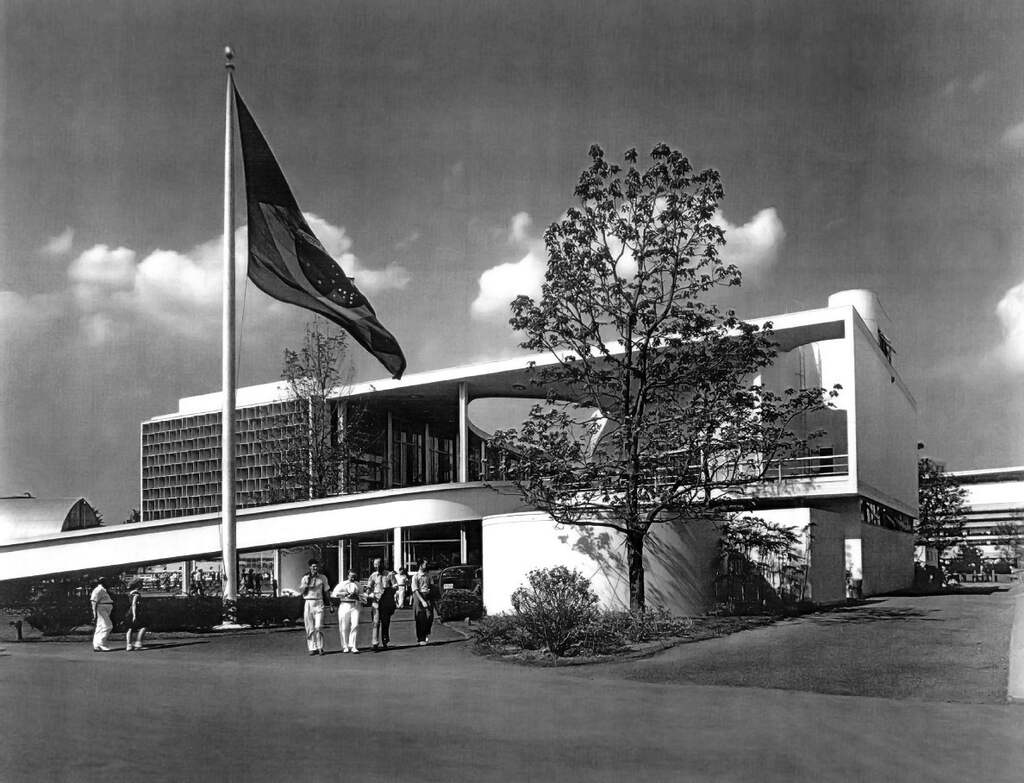
Just a few years later, in 1939, after being a finalist in the World’s Fair competition, Niemeyer was invited by Lúcio Costa to help design the Brazilian Pavilion.
Originally intended as a temporary structure, the pavilion lasted “only one season.”
Yet, it already displayed the theatricality that would later define Niemeyer’s work.
With grace, lightness, and transparency, the pavilion was conceived as a traveling spectacle: its structure evoking a stage set.
Despite its futuristic character, it engaged with classical and vernacular traditions: its axial layout, courtyard, and peristyle echoed Roman villas.
From the sweeping curves of its entrance to the expressive use of water and even Amazonian plants, everything was designed to poetically embody Brazil’s spirit.
3. Pampulha architectural complex
In the early 1940s, Niemeyer expanded his love for curves on a larger scale at Pampulha in Belo Horizonte.
Commissioned by Juscelino Kubitschek in 1940, the complex included the Church of Saint Francis of Assisi, the Pampulha Art Museum, the Casa do Baile, and other buildings surrounding the artificial lagoon.
Niemeyer’s selection reflected the prestige he had gained with the Brazilian Pavilion in New York and laid the foundation for his later ambitions in Brasília.
At Pampulha, Niemeyer pushed the plasticity of reinforced concrete further. The Church of Saint Francis of Assisi stands as the most iconic example, distinguished by its parabolic vaults.
In 2016, UNESCO recognized the Pampulha Complex as a World Heritage Site, praising it for “exploring the plastic potential of concrete” and for “fusing architecture, landscape design, sculpture, and painting into a harmonious whole.”
Today, it remains both a postcard of Belo Horizonte and a milestone that launched Niemeyer into international recognition, opening the way for Brasília.
4. Copan Building
In the 1950s, São Paulo’s skyline gained a striking new landmark: the Copan Building.
Designed for São Paulo’s IV Centenary, its S-shaped structure, rising 32 stories and divided into six blocks, housed more than 1,000 apartments for different social classes, along with shops and restaurants at street level.
It was in this context of rapid verticalization that Niemeyer’s monumental architecture found fertile ground.
His signature curves softened the rigidity of the city’s skyline: the S-shaped façade flows like a continuous gesture, while horizontal brise-soleil panels reinforced the undulating form and protected interiors from the sun.
The Copan’s historical and architectural value was officially recognized when it was listed by IPHAN in 2007 and CONPRESP in 2012, ensuring the preservation of its original features.
5. Palácio da Alvorada
When Brasília’s construction began, Niemeyer was the obvious choice to design its monuments.
In April 1957, he began work on the Palácio da Alvorada, the first masonry building of the new capital, distinguished by elegant columns that appear to float above the ground.
Covering about 7,000 m² across three levels: basement, ground floor, and second floor the palace serves both residential and ceremonial purposes.
The basement houses a movie theater, laundry, and medical center. The ground floor contains the State Hall, library, and mezzanine, while the upper floor holds the President’s private quarters.
Completed in 1958, its name was coined by Kubitschek himself: “What is Brasília if not the dawn of a new day for Brazil?”
6. Palácio do Planalto
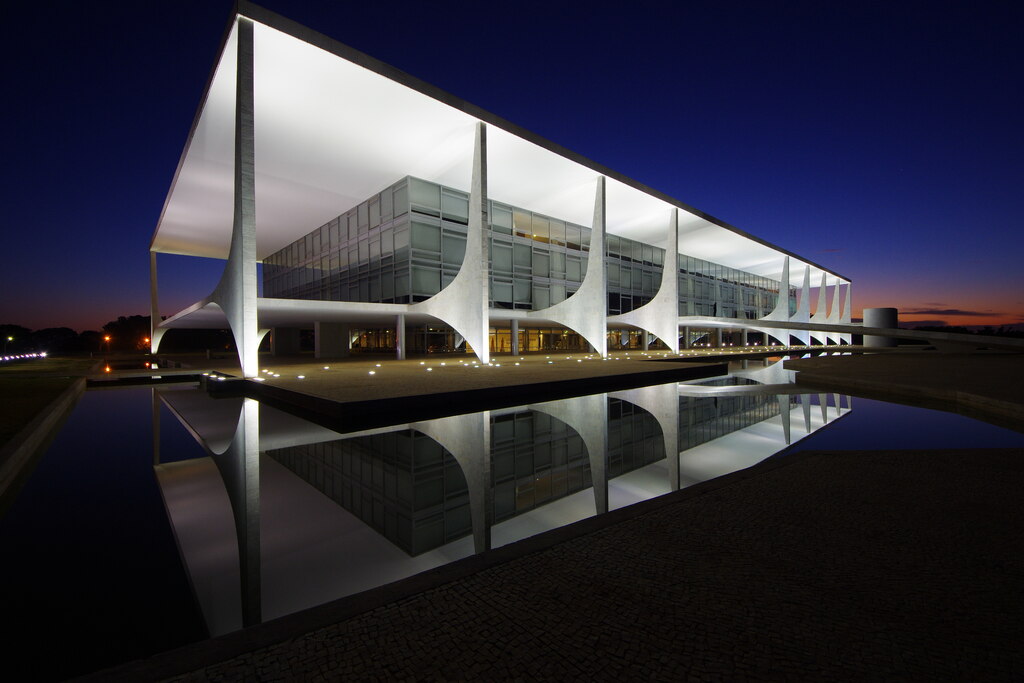
Construction of the Palácio do Planalto began on July 10, 1958. Its design featured elegant, curved “sails” along the façade and a base elevated on slender pilotis.
The building was inaugurated together with the National Congress and the Supreme Federal Court (STF) on April 21, 1960, during Brasília’s official opening ceremonies, symbolizing strength combined with lightness.
The Planalto Palace embodies Niemeyer’s architectural essence: clean horizontal lines softened by subtle curves that lend a sense of lightness to reinforced concrete.
Fittingly, Niemeyer’s wake in 2012 was held on the presidential ramp of this very palace.
7. National Congress
The National Congress is arguably one of Niemeyer’s most important and iconic works.
Inaugurated on April 21, 1960, it became the symbol of Brazil’s Legislative Power and a landmark of modernist architecture.
Niemeyer’s design placed a horizontal platform at the center, topped by two opposing domes and flanked by twin 28-story office towers.
The Senate’s inverted dome posed one of the greatest engineering challenges, a feat made possible by Niemeyer’s trusted collaborator, engineer Joaquim Cardozo.
8. Metropolitan Cathedral of Brasília
Another emblematic Niemeyer creation is Brasília’s Metropolitan Cathedral.
Instead of massive, heavy volumes, Niemeyer conceived a soaring composition:16 curved concrete columns, each 60 meters tall, rising skyward like a crown of thorns.
Inside, light itself becomes material. Marianne Peretti, the only woman on Niemeyer’s Brasília team, designed the stained-glass windows: 16 panels, each over 30 meters tall, in shades of blue, green, and amber, casting an ethereal glow throughout the space.
At the entrance, four bronze statues, each three meters tall, by Alfredo Ceschiatti and Dante Croce, stand as silent sentinels welcoming visitors.
9. Palácio Itamaraty
Rounding out Niemeyer’s Brasília monuments is the Palácio Itamaraty, aptly nicknamed the “Palace of the Arches.”
Inaugurated on April 21, 1970, Itamaraty houses Brazil’s Ministry of Foreign Affairs. The building was the product of Niemeyer’s collaboration with engineer Joaquim Cardozo and the landscape designer Roberto Burle Marx.
The project began in 1959, when Ambassador Wladimir Murtinho outlined the diplomatic requirements for the new capital.
In its reflecting pool stands Meteoro, a Carrara marble sculpture by Bruno Giorgi weighing over 50 tons. Commissioned in 1967 and awarded in Milan, it represents the diplomatic bonds uniting the five continents.
10. Niterói Contemporary Art Museum (MAC)
Inaugurated on September 2, 1996, atop Boa Viagem Cliff, the Niterói Contemporary Art Museum (MAC) is one of Niemeyer’s most recognizable works.
Suspended over Guanabara Bay, the museum holds a collection of 1,217 pieces of contemporary Brazilian art.
Resembling a “flying saucer,” the MAC is a perfectly balanced cylinder supported by a single concrete “stem.”
So iconic, it was even adopted as Niterói’s official logo, symbolizing the “Niemeyer effect” on the city’s urban identity.
11. Oscar Niemeyer Museum (MON)
The Oscar Niemeyer Museum (MON), affectionately known as the “Eye Museum,” is another of his most striking works.
Opened on November 22, 2002, as the “New Museum” and renamed on July 8, 2003, it spans 35,000 m², with 17,000 m² dedicated to exhibitions.
Beyond its singular architecture, MON features a collection of around 14,000 works spanning visual arts, architecture, and design.
In 2014, CNN ranked it among the 20 most beautiful places in Brazil, and it continues to rank among the world’s most visited museums year after year.
Want to design in BIM like Niemeyer? Count on the Blocks Plugin!
Designing like Niemeyer may be nearly impossible, his artistry was unique and shaped Brazilian architectural history.
But that doesn’t mean you can’t achieve equally remarkable results in your own projects.
With the Blocks plugin, you can transform your designs into iconic works, just as Niemeyer did.
It offers over 5,000 parametric families to turn your BIM projects into architectural masterpieces.
Ready to bring a Niemeyer-level expression to your Revit workflow? Download the Blocks Plugin for free.

Conclusion
Oscar Niemeyer’s architecture shows us that concrete can be more than mere structure: it can be gesture, movement, and connection.
Each curve Niemeyer drew was not meant only to delight the eye, but to open spaces for gathering, to reflect our identity, and to invite us into a collective dream.
When you cross the Cathedral’s ramp or feel the lightness of the Planalto’s columns, you realize he was not just an architect focused on technique, but someone who believed in the transformative power of form.
It is this combination of boldness and humanity that makes Niemeyer’s work stand the test of time and inspire those who write, those who design, and those who inhabit the city.
Enjoyed this content? For more like it, follow the Blocks blog!