
If you are passionate about modern architecture, chances are you’ve already heard of the Dutch artistic movement known as De Stijl.
Marked by iconic works such as the Red Blue Chair, De Stijl helped shape the modernist avant-garde and its offshoots, including architecture and design.
In the early 20th century, this movement revolutionized art by bringing painting, design, and modernist construction together into a single, cohesive vision.
In this article, we’ll explore what De Stijl was, its history, the defining architectural characteristics of the movement, and its most iconic works.
So, ready to understand its influence on architecture? Enjoy your reading!
What is De Stijl?

Piet Mondrian
1872 – 1944
“To approach the spiritual in art, one must make as little use of reality as possible, because reality stands in opposition to the spiritual.”
De Stijl (a Dutch term meaning “The Style”) was an avant-garde artistic movement that emerged in the Netherlands in 1917.
Founded by artists and architects such as Theo van Doesburg and Piet Mondrian, the movement aimed to create something entirely new, based on geometric abstraction and harmony between colors and forms.
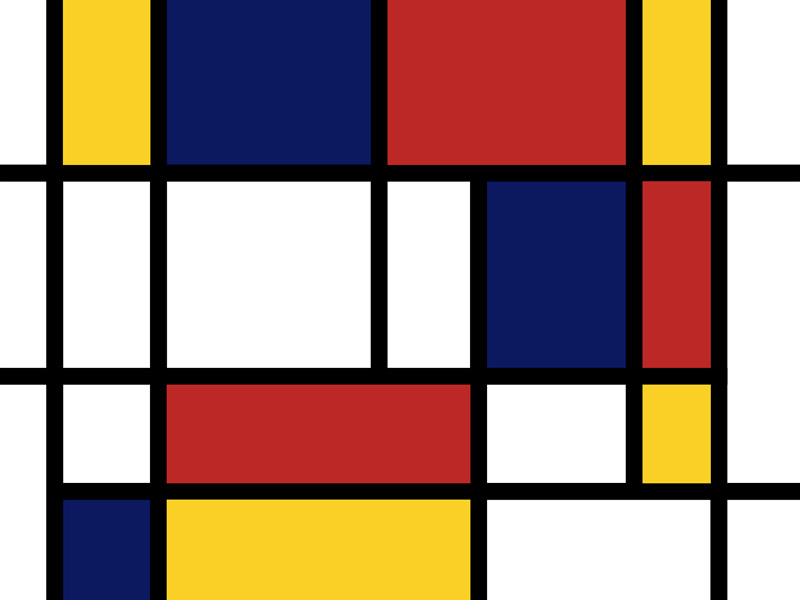
Rather than depicting real-world objects in their paintings, De Stijl artists worked exclusively with basic elements: rectangles, vertical and horizontal lines.
Although known as De Stijl, the movement also became widely recognized as Neoplasticism, as it proposed a “new visual language” for art.
What is modernist architecture?
To fully understand De Stijl, it’s essential to first understand modernist architecture, which serves as the foundation of the Dutch movement.
Modernist architecture is grounded in rationality and functionality. It rejects excessive ornamentation and favors simple, clean forms.
It emerged in the first half of the 20th century alongside the development of new construction materials such as reinforced concrete, steel, and glass, fundamentally reshaping how buildings were designed and constructed.
Some well-known architects associated with modernist architecture include Lina Bo Bardi (Glass House), Oscar Niemeyer (Brasília), Ludwig Mies van der Rohe (Farnsworth House), and Paulo Mendes da Rocha (Casa Butantã).
Although each of these architects developed a unique design language, their work shares common conceptual roots.
During the modernist avant-garde, countless artistic movements emerged and De Stijl was part of this innovative landscape.
De Stijl: key characteristics of the movement in architecture
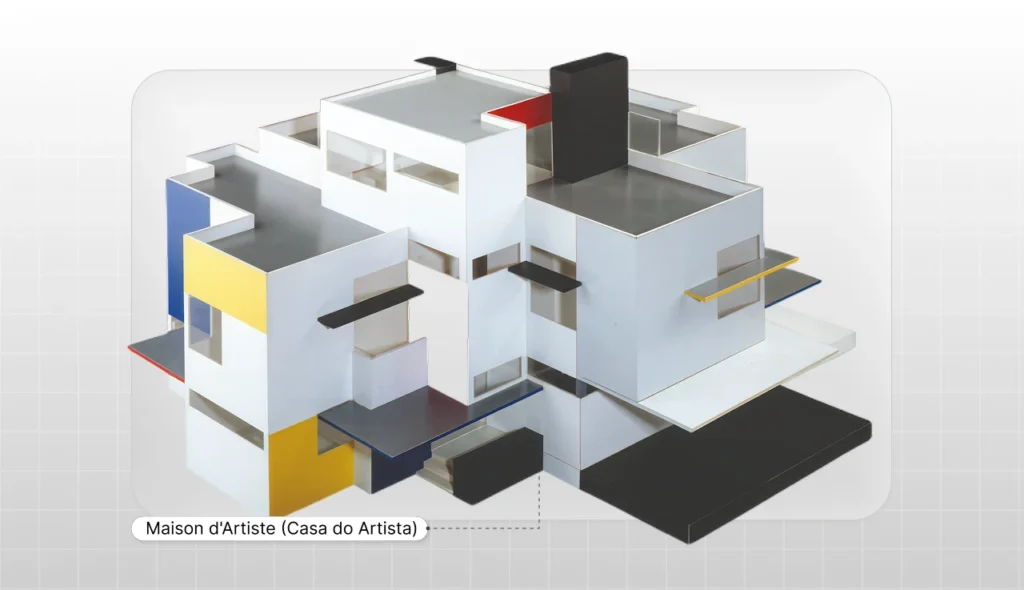
Now that you understand both De Stijl and modernist architecture, it’s time to explore the defining characteristics of the movement.
- Geometry and straight lines: Rigorous geometry is one of the defining traits of De Stijl’s. In architectural works, nearly everything is reduced to straight lines and 90-degree angles.
- Clear and modular structure: Another hallmark of De Stijl architecture is its clearly expressed, modular structure. Instead of concealing construction elements, Neoplastic architects highlighted them as part of the composition. In the Schröder House, Gerrit Rietveld took this concept to the extreme. The house was designed as a composition of independent planes and lines, where each wall appears to float, forming a cohesive modular whole.
- Integration of art and architecture: De Stijl architecture maintained a strong connection to visual arts and design. Houses were not only functional but were conceived as “habitable paintings”, in which every detail followed the same principles of form and color. Rietveld, for example, designed iconic furniture specifically for his architectural projects.
- Restricted color palette: When we think of De Stijl, primary colors immediately come to mind: red, blue, and yellow. This limited color palette is a signature of the movement. In architectural works, surfaces are typically white or gray, while structural elements are highlighted with primary colors.
- Open and flexible spaces: Finally, De Stijl architects innovated by pursuing open floor plans and flexible spaces, breaking away from the compartmentalized houses of the time. In the Schröder House, Rietveld designed sliding walls on the upper floor that could be retracted during the day, transforming individual rooms into a large, open space.
In short, De Stijl architecture relies on few elements, but each one is striking, from the use of primary colors to solid geometric forms.
What was the main objective of the De Stijl movement?
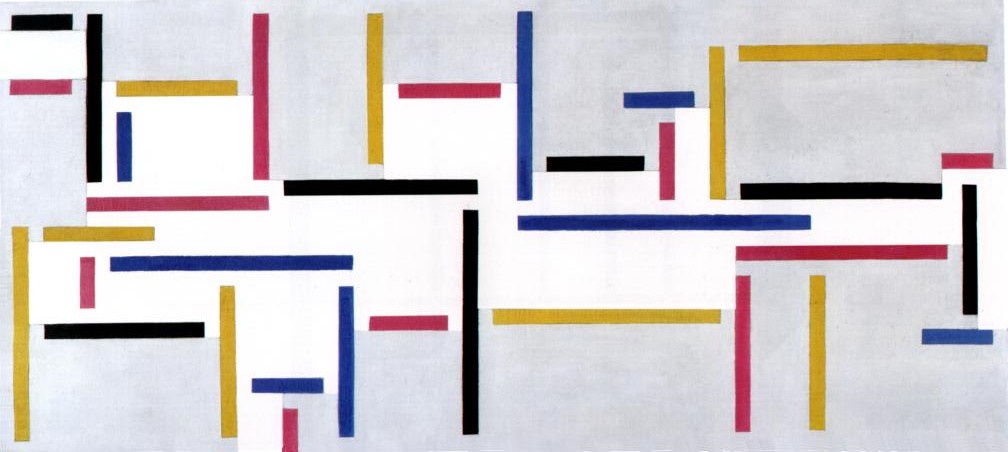
The primary goal of De Stijl was to create a universal visual language capable of expressing order, balance, and harmony through essential means.
As a result, works were composed primarily of straight lines (vertical and horizontal), orthogonal planes, and a limited color palette.
The intention was to eliminate any naturalistic references in pursuit of a “pure” beauty that could be applied equally to painting, design, and architecture.
In essence, De Stijl sought to unify the arts and offer a shared vocabulary for modern life, understood as a universal language for a new era.
Was there a De Stijl design school?
There was no formal “De Stijl school” in the institutional sense, as there was with the Bauhaus in Germany.
De Stijl developed around a magazine of the same name, founded in 1917 by Theo van Doesburg, which served as a platform for gathering and disseminating the group’s ideas. Contributors included Piet Mondrian, Gerrit Rietveld, J.J.P. Oud, Vilmos Huszár, and Bart van der Leck.
Rather than an official school, De Stijl functioned as an intellectual circle, serving as a hub for both theory and practice.
That said, there was a clear exchange of ideas with the Bauhaus. Van Doesburg gave lectures and private courses in Weimar and maintained close dialogue with Bauhaus teachers and students.
De Stijl architectural works
After exploring the history of De Stijl, let’s take a closer look at its most iconic works.
Rietveld Schröder House
Interior and exterior areas of the Schröder House | Credits: Amazing Interiors®
The Schröder House (Rietveld Schröderhuis, in Dutch) is arguably the most famous architectural work associated with De Stijl.
Designed in 1924 by architect Gerrit Rietveld for Mrs. Truus Schröder in Utrecht, the house represented a radical turning point in modern architecture.
Its façade resembles a three-dimensional Mondrian painting: white and gray planes intersected by black, red, blue, and yellow lines and rectangles.
The floor plan is exceptionally innovative, featuring modular elements and movable interior walls that can be reconfigured according to the occasion.
In recognition of its significance, the Schröder House was designated a UNESCO World Heritage Site in 2000 and is considered one of the masterpiece of De Stijl.
Red Blue Chair
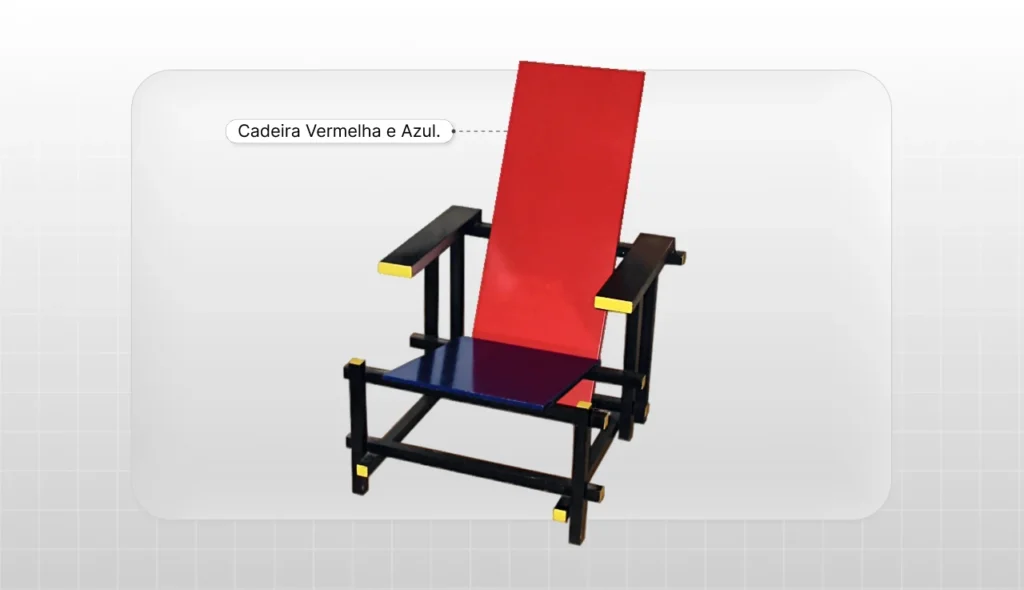
In the world of furniture design, few objects capture the spirit of De Stijl as clearly as the Red Blue Chair.
Also created by Gerrit Rietveld in 1917, it became one of the movement’s most iconic symbols.
The chair is composed of wooden planes arranged at right angles and painted in primary colors. The seat is blue, the backrest is red, and the structure is black with yellow accents.
At the time, Rietveld designed the chair with functionality and ease of mass production in mind.
Today, it can be found in design museums around the world and continues to inspire designers with its boldness and simplicity.
Zig-Zag chair
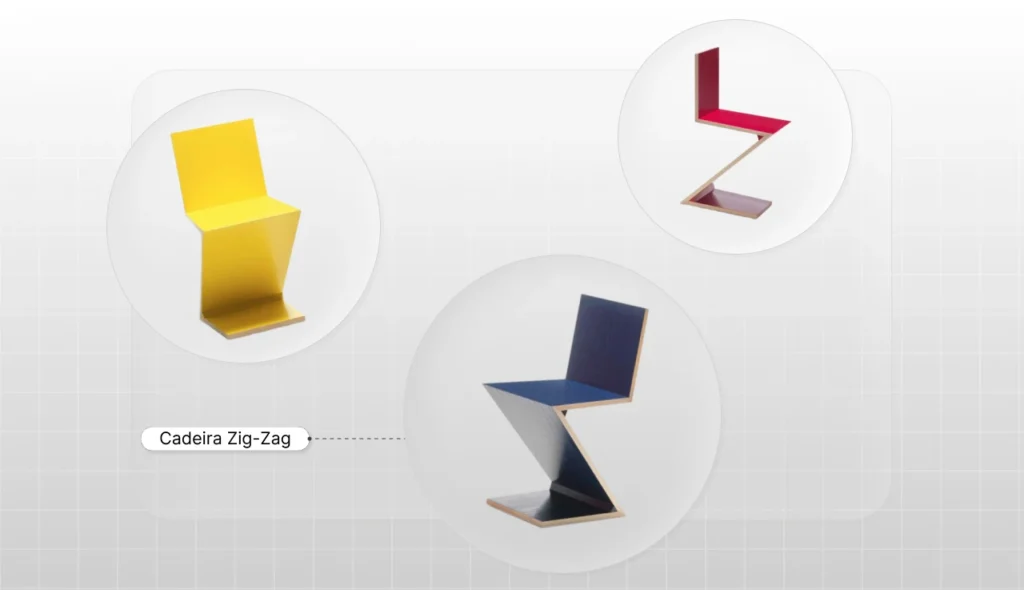
Another design piece associated with De Stijl, also created by Gerrit Rietveld, is the Zig-Zag Chair.
Designed in 1934, it represents a further step in the pursuit of minimalism within furniture design.
The Zig-Zag Chair consists essentially of four flat wooden planes arranged in a “Z” shape, without traditional front or back legs.
It follows Neoplastic principles: straight lines forming the letter “Z” and, in many versions, the use of primary colors.
To this day, the Zig-Zag Chair remains in production and is celebrated as a classic of modern design.
Bonus: Composition XXII (1922)
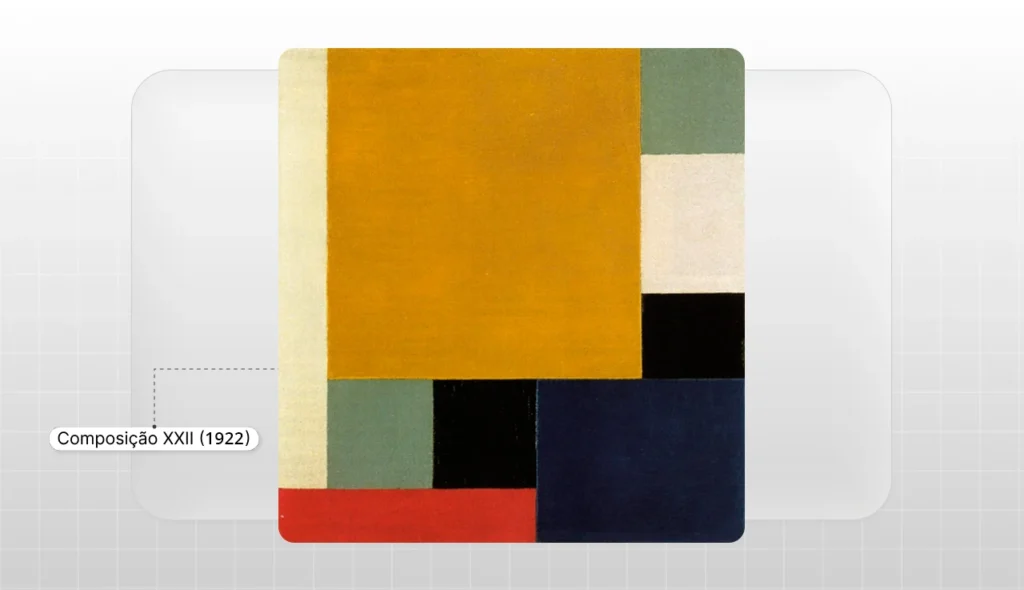
Composition XXII (1922) by Theo van Doesburg offers an excellent visual summary of De Stijl’s ideals: orthogonality, formal reduction, and a palette of primary and neutral colors.
The oil-on-canvas painting measures 45.5 × 43.3 cm and is housed at the Van Abbemuseum in Eindhoven.
Behind the work lies a compelling story. In letters written between 1921 and 1922, Van Doesburg describes the chromatic impression he experienced while viewing the Côte d’Azur during a train journey.
Composition XXII was created for Thijs Rinsema, brother of poet Evert Rinsema, and sent to him in the summer of 1922.
Thijs himself enthusiastically described the painting’s “golden yellow” tone when hanging it in his De Stijl-inspired room in Drachten.

Conclusion
The De Stijl movement demonstrates how simplicity can spark a profound aesthetic revolution.
More than a century later, its influence remains visible in both architecture and interior design.
De Stijl reminds us that, in many cases, less truly is more when it comes to architecture and design.
If you enjoyed this article, be sure to share it on your social networks and follow the Blocks blog for more content like this.